The 2026 EOFY Strategic Guide for Australian Mid-Market Corporate Leaders

The 2026 EOFY Strategic Guide for Australian Mid-Market & Corporate Leaders
The End of Financial Year (EOFY) presents a defining moment for Mid-Market Enterprises, Corporate Groups, Large Private Entities, and Sizable Not-for-Profits (NFPs) within the Australian economic landscape. Organisations with revenues ranging from $10 million to $100 million and beyond face increasingly intricate fiscal environments demanding astute governance and unwavering commitment to operational leverage and fiscal efficiency. With EOFY 2026 upon us in June 2026, Chief Financial Officers, Finance Directors, and executive leaders must adopt a boardroom-level perspective—emphasising strategic resource allocation, meticulous compliance, and scalable financial stewardship—to secure organisational resilience and competitive advantage.
Strategic Priorities for EOFY Mastery in Complex Enterprise Contexts
Excellence in EOFY outcomes for large-scale Australian organisations necessitates a holistic integration of foresight, operational discipline, and governance principles. Foundational to this is the anticipation and mitigation of risks inherent in multi-entity consolidation, regulatory adherence, and evolving market dynamics.
Collectively, these imperatives underpin an agile and resilient EOFY execution framework essential for sustained fiscal discipline and optimisation of capital and operational resources.
- Proactive EOFY Planning and Governance: Establish a rigorous, board-approved EOFY roadmap with clear milestones and ownership. Early engagement of stakeholders—including finance, legal, audit, and operational divisions—ensures comprehensive risk identification and mitigation within intercompany reconciliations and consolidation protocols.
- Real-Time Data Integrity and Financial Record-Keeping: Deploy continuous reconciliation processes and maintain financial records with granularity to support transparent external audit requirements, executive reporting, and scenario-based decision-making.
- Adoption of Advanced Financial Ecosystems: Leverage integrated accounting suites, predictive analytics, and AI-driven forecasting tools. Such platforms enhance operational leverage by automating routine tasks, providing dynamic insights, and reinforcing governance through audit trails and compliance checks.
In-Depth Fiscal Planning and Resource Allocation
EOFY represents a strategic fulcrum whereby Mid-Market Enterprises and Corporate Groups exercise stewardship over liquidity, capital deployment, and long-term growth trajectories. Expanding on traditional planning disciplines through enhanced forecasting and scenario analysis drives executive alignment and agility for the 2026-27 Financial Year.
This elevated financial planning discipline transcends mere compliance, serving as a tactical enabler for sustainable competitive differentiation.
- Dynamic Cash Flow Optimisation: Employ sophisticated liquidity management models with real-time monitoring capabilities. This approach aligns working capital with operational demands and prudential capital allocation while illuminating optimal windows for strategic investment or divestment.
- Robust Budgeting Frameworks with Scenario Analysis: Embed sensitivity modelling and contingency planning into budgets, allowing executive teams to recalibrate strategies responsively amid volatility.
- Strategic Capital Expenditure Governance: Enforce stringent capital investment appraisal aligned with enterprise-wide objectives and current market conditions, ensuring that funds deployment advances scalable growth and operational leverage.
Comprehensive Compliance Architecture for Large Entities
- Alignment with Australian Accounting Standards Board (AASB) Directives: Transparent, timely financial reporting is non-negotiable to maintain stakeholder trust and legal compliance.
- Comprehensive Documentation and Audit Trails: Detailed documentation supports verification processes and smooth audit engagements, facilitating executive oversight and regulatory confidence.
Compliance Obligations Differentiated by Entity Type
To provide clarity on compliance obligations across different entity types, the following table presents a comparison of requirements:
Customising governance frameworks in accordance with these distinctions enhances compliance integrity and executive accountability.
Elevated EOFY Best Practices and Governance Controls
Corporate leaders must instil EOFY processes as strategic governance pillars, transcending routine compliance to embed operational leverage, transparency, and executive accountability.
Such disciplines cultivate a governance culture centred on continual improvement and risk mitigation.
- Frequent Financial Reviews and Rigorous Reconciliations: Implement mandatory monthly or quarterly reconciliations and variances analyses to pre-empt disruptions and reinforce audit readiness.
- Engagement with Specialist Professional Advisors: Strategic partnerships with domain experts in regulation, technology, and financial management amplify governance capabilities and mitigate emerging risks.
- Continuous Team Capability Enhancement: Invest in the professional development of finance teams to ensure proficiency in evolving regulatory landscapes and advanced fiscal methodologies.
EOFY Strategies Tailored for $10M+ Organisations
Enterprises exceeding $10 million in revenue confront complexities including multi-entity consolidations, diverse revenue portfolios, and sophisticated intercompany transactions that demand elevated EOFY strategies:
Executive oversight and resource allocation must be scaled appropriately to address these dimensions without sacrificing governance rigor or operational agility.
- Considerations include implementing distinct EOFY processes that address multi-entity structures, as well as ensuring that compliance measures align with more rigorous reporting standards. DeImplementation of rigorous intercompany reconciliation protocols and consolidation standards ensuring compliance with applicable accounting frameworks
- Calibration of compliance mechanisms attuned to intensified regulatory scrutiny and organisational scale.
Key Compliance Frameworks within the 2026 Regulatory Milieu
Legislative Intent and Principles
Minimum Yearly Repayments (MYR) and Calculation Formulas
Deemed Dividend Consequences
Written Loan Agreements: Essential Compliance Documentation
These agreements detail interest rates, loan term, repayment schedules, and security, providing documentary evidence for Division 7A compliance.
CFO Governance and Control Imperatives
Robust governance frameworks involve regular Division 7A compliance reviews, approvals for all associated party loans, and systematised tracking of repayments aligned with approved agreements. These controls mitigate fiscal exposure and preserve capital efficiency.
Ordinary Family Dealings Versus Reimbursement Agreements
Corporate leaders must distinctly classify genuine family dealings from reimbursement agreements. The latter, absent legitimate commercial basis, attract substantial penalties and risk reputational damage.
Bulletproof Streaming Resolution Execution by 30 June 2026
EOFY governance requires that trust income streaming resolutions be meticulously prepared and executed on or before 30 June 2026, ensuring the robustness of beneficiary income allocations against potential Section 100A challenges.
Complexities of Managing Over 20 Vehicle Fleets
- Statutory Formula Method: Applies a flat statutory rate based on kilometres travelled, simplifying calculation but with fixed assumptions.
- Operating Cost Method: Requires comprehensive tracking of actual vehicle costs and business use percentages, offering precision but increased administrative burden.
Entertainment Facility Benefits: Compliance Traps
Reporting Deadlines and Instalment Strategies
Implementing quarterly instalments aids cash flow management and compliance consistency.
Systemic Risk to Corporate Governance: The Talent Shortage Imperative
The prevailing shortfall in skilled finance personnel within mid-market and corporate environments transcends operational inconvenience to represent a profound systemic risk affecting reporting integrity and regulatory compliance.
Implications include:
Business Avengers emerges as a strategic governance partner, providing on-demand fiscal expertise and scalable resource augmentation. Their capabilities enhance organisational resilience, sustain governance controls, and ensure precision in complex, multi-entity EOFY processes.
- Material Risk to Financial Reporting Integrity: Staff shortages compromise the accuracy and timeliness of financial disclosures, undermining stakeholder confidence and boardroom oversight.
- Burnout Domino Effect: Heightened workload pressures catalyse workforce attrition, exacerbating institutional knowledge loss and escalating compliance vulnerabilities.
- Knowledge Vacuum and Governance Gaps: The departure of experienced professional talent creates capability voids diminishing strategic financial management and risk mitigation.
Strategic EOFY Checklist: Board-Level Accountability and Milestone Oversight
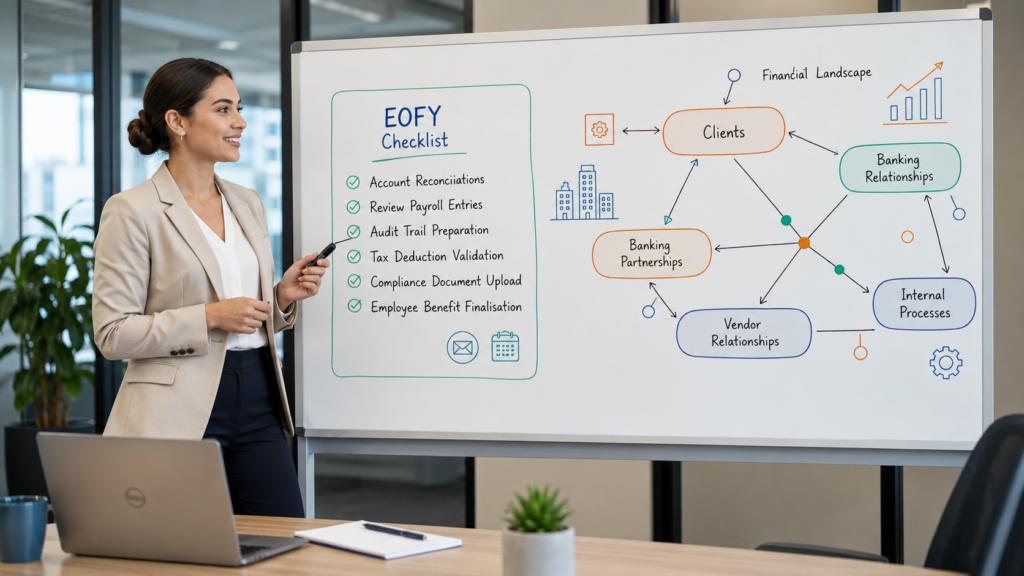
For leadership teams steering expansive enterprises, a comprehensive, board-endorsed EOFY checklist detailing responsibilities and deadlines fortifies governance and operational excellence:
Formalising these actions with explicit role delineation and timeframes mitigates risks and empowers executive decision-making.
- Intercompany Reconciliations and Multi-Entity Consolidations — Completion by 15 May. Financial Controllers and Group Accountants to verify balance integrity and adherence to accounting standards.
- Financial Statement Preparation and External Audit Coordination — Draft completion by 31 July; audit finalisation by September end. CFOs and Audit Committee Chairs maintain oversight and liaison.
- Compliance Record Maintenance and Governance Documentation — Ongoing throughout the fiscal year. Compliance Officers to sustain documentation accuracy and archivability.
Business Avengers: Premier Strategic Partner for Fiscal Excellence and Governance Advantage
In an era marked by increasing complexity and regulatory demands, Mid-Market Enterprises and Corporate Groups must eschew ad hoc or cost-centric approaches in favour of premium, strategically aligned partnerships. Business Avengers provides an elite, scalable resource model enabling entities to elevate capital efficiency, operational leverage, and governance sophistication.
Business Avengers represents a competitive moat—delivering robust governance advantage, reinforcing board-level confidence, and underpinning strategic fiscal leadership.
- Capital Efficiency through Strategic Resource Allocation: Facilitates optimum utilisation of fiscal resources, avoiding the fixed costs associated with permanent team expansion.
- Operational Leverage via Expertise and Technology: Access to specialist finance professionals and advanced platforms streamlines EOFY workflows and enhances data integrity.
- Strategic Risk Mitigation: Reduces exposure to systemic risks associated with talent shortages and compliance failures.
- Tailored Services Aligned to Complex Enterprise Needs: Solutions encompass multi-entity consolidations, regulatory compliance, and executive reporting support.
Want to talk any of this through with a finance leader who has run these functions?
Was this article helpful?

Rohit Maloo
Chief Operating Officer, Business Avengers
Chartered accountant, ex investment banker and fully understands the Australian landscape.