A CFO’s Guide to Preparing Financial Statements for Your Board
Financial statements are one of those things that look simple from the outside (a profit and loss, a balance sheet, a cash flow statement) and get genuinely complicated the moment your business has more than one revenue stream, a lease, some inventory, or a part-owned asset. Get them wrong and the damage compounds. Bad statements produce bad forecasts, bad forecasts produce bad decisions, and by the time anyone notices, it's a much bigger problem than a misclassified line item. This guide is for the CFO or finance lead who has to hand statements to a board, lender, or investor and needs them to hold up to scrutiny, not just balance.
What Financial Statement Preparation Actually Involves
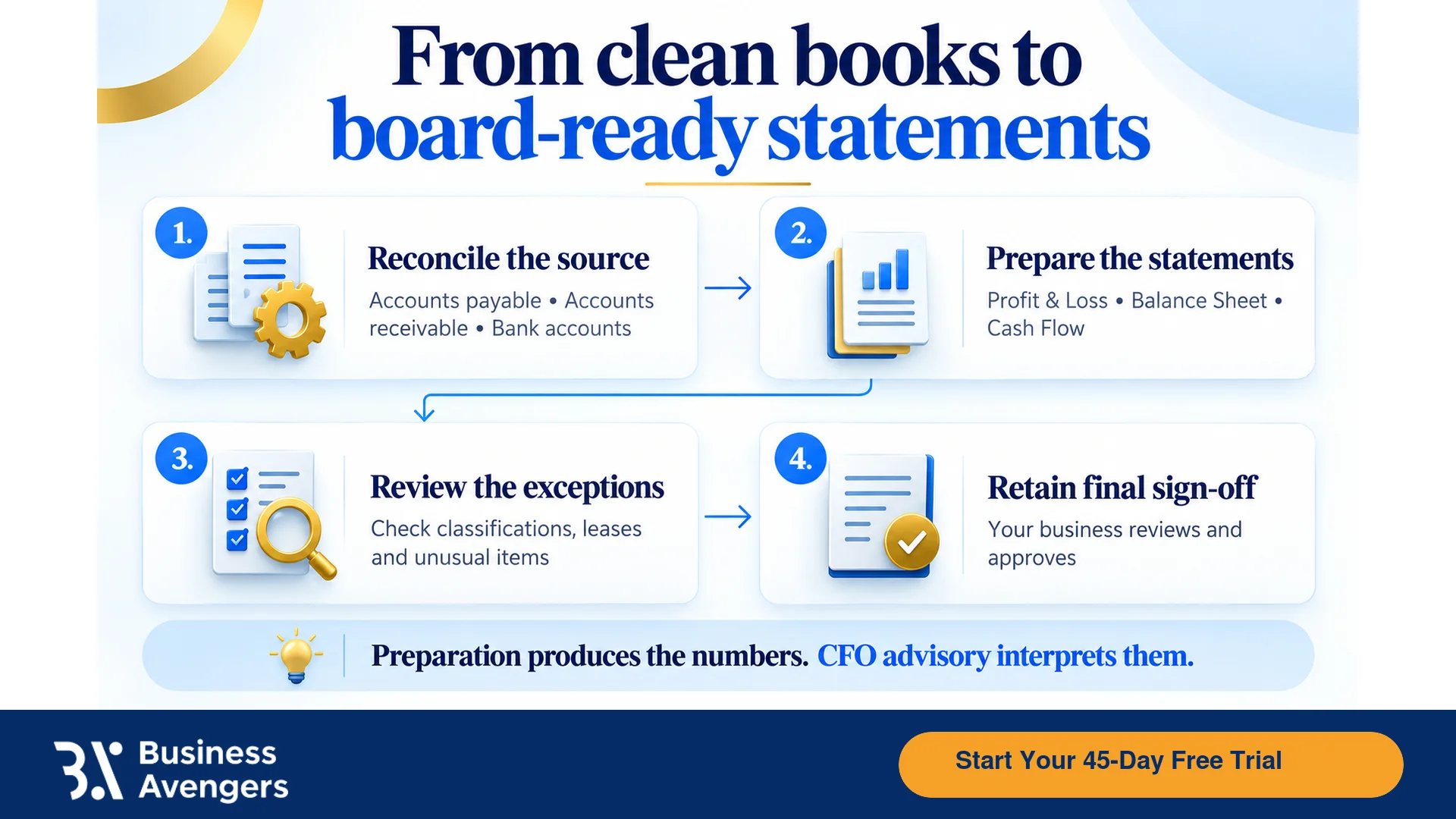
At a proper standard, this covers profit and loss, balance sheet and cash flow statement preparation. Statements should align with Australian Accounting Standards and be kept audit-ready. Our audit support services guide covers what that readiness actually looks like in practice. This section also covers reconciling the underlying accounts payable, accounts receivable, and bank reconciliations that feed into the statements, plus monthly or quarterly management reporting packages for boards and stakeholders. Notes and disclosures required for statutory reporting should reflect ASIC's financial reporting guidance for your business structure. Statement preparation sits downstream of clean transactional bookkeeping, which is why a provider who also handles your day-to-day bookkeeping tends to produce more accurate statements than one that's only handed a trial balance at month-end.
The Errors Outsourcing Prevents
A lot of financial statement problems trace back to a small number of recurring, avoidable errors. Cash flow statement errors are common, with misclassified financing vs. operating activities being one of the most frequent and most consequential. Fixed asset and depreciation misclassification shows up particularly around lease accounting, especially for businesses managing leased equipment or premises. And emerging asset classes with unclear treatment are an increasing issue: businesses holding crypto or digital assets face genuinely unsettled accounting treatment in Australia, which is why errors there are common simply because guidance is still evolving. Our guide to common errors in cash flow statements goes deeper on the first of these.
Why This Is Getting More Complex, Not Less
A few 2026-specific pressures are worth flagging. Reporting cadence expectations are rising, boards, lenders, and investors increasingly expect monthly, not just annual, statements, which multiplies the workload for teams already stretched by the accounting talent shortage. AI is changing how statements get produced, not just who produces them: automated reconciliation and anomaly-flagging tools, such as Business Avengers' Becide reporting automation, mean fewer manual errors reach the final statement, but only if the team using them knows how to interpret the flags rather than rubber-stamping the output. And EOFY concentrates the risk: every EOFY, the gap between businesses with clean, current statements and those catching up becomes obvious.
Financial Statement Preparation vs. CFO Advisory: Where's the Line?
Financial statement preparation produces the numbers; CFO advisory interprets them through forecasting, scenario planning, and strategic recommendations built on top of accurate statements. You can outsource one without the other, but a lot of businesses find the two work best together, since a CFO's advice is only as good as the statements it's based on.
What to Look for in a Provider
- Accounting standards experience relevant to your structure. Company, trust, and NFP reporting requirements differ meaningfully.
- Integration with your existing bookkeeping and reconciliation data, rather than working from a disconnected trial balance handed over monthly.
- Audit-readiness by design, not as an afterthought.
- A trial period to assess accuracy and communication before committing.
- Transparent turnaround times for monthly or quarterly reporting packages, agreed upfront.
FAQ
How is outsourced financial statement preparation different from bookkeeping?
Bookkeeping records day-to-day transactions; financial statement preparation compiles and presents that data as formal statements (P&L, balance sheet, cash flow) suitable for boards, lenders, or statutory reporting. The two are closely linked but distinct.
Can outsourced financial statement preparation help with investor or lender reporting?
Yes. This is a common use case, particularly for businesses needing to produce more frequent, more polished reporting packages than their internal team currently has capacity for.
Does outsourcing financial statement preparation affect who owns the numbers?
No, you retain ownership and final sign-off. The provider prepares the statements; final review and approval remain with your business and your auditor or accountant where relevant.
How often should financial statements be prepared?
Increasingly, monthly is the expectation for businesses with active board oversight or external investors, though quarterly remains common for smaller or simpler structures.
What happens if errors are found in previously prepared statements?
A good provider will correct and explain any errors transparently as part of the ongoing relationship. This is one of the reasons continuity with a dedicated team, rather than a new preparer each period, matters for consistency.
The Bottom Line
Financial statement preparation is easy to underestimate until something goes wrong with it: a misclassified lease, an unreconciled account, an unclear crypto holding, and by then it's already fed into a forecast or a board decision. Outsourcing this to a team that also owns the underlying bookkeeping tends to produce more accurate, more audit-ready statements than treating it as a disconnected, end-of-month exercise. Talk to us about your current reporting setup.
Want to talk any of this through with a finance leader who has run these functions?
Was this article helpful?

Dilip Kherajani
CPA, Australia and Financial Strategist
20+ years of experience in Finance across multiple industries and geographies, 10+ of them as a CFO.