Complete Guide to Hiring Outsourced Bookkeeping Services Australia
There's a specific moment every growing Australian business hits when the spreadsheet-and-a-part-time-bookkeeper setup that worked fine at $5M in revenue starts creaking at $10M. Invoices get missed. Reconciliations slip. You find out about a cash flow problem three weeks after it started, not three weeks before. That's usually when outsourced bookkeeping services australia starts showing up in your search history. This guide covers what's actually included, what it costs, and, more importantly, how it's different from just hiring a local bookkeeper on a retainer.
What Do Outsourced Bookkeeping Services Actually Include?
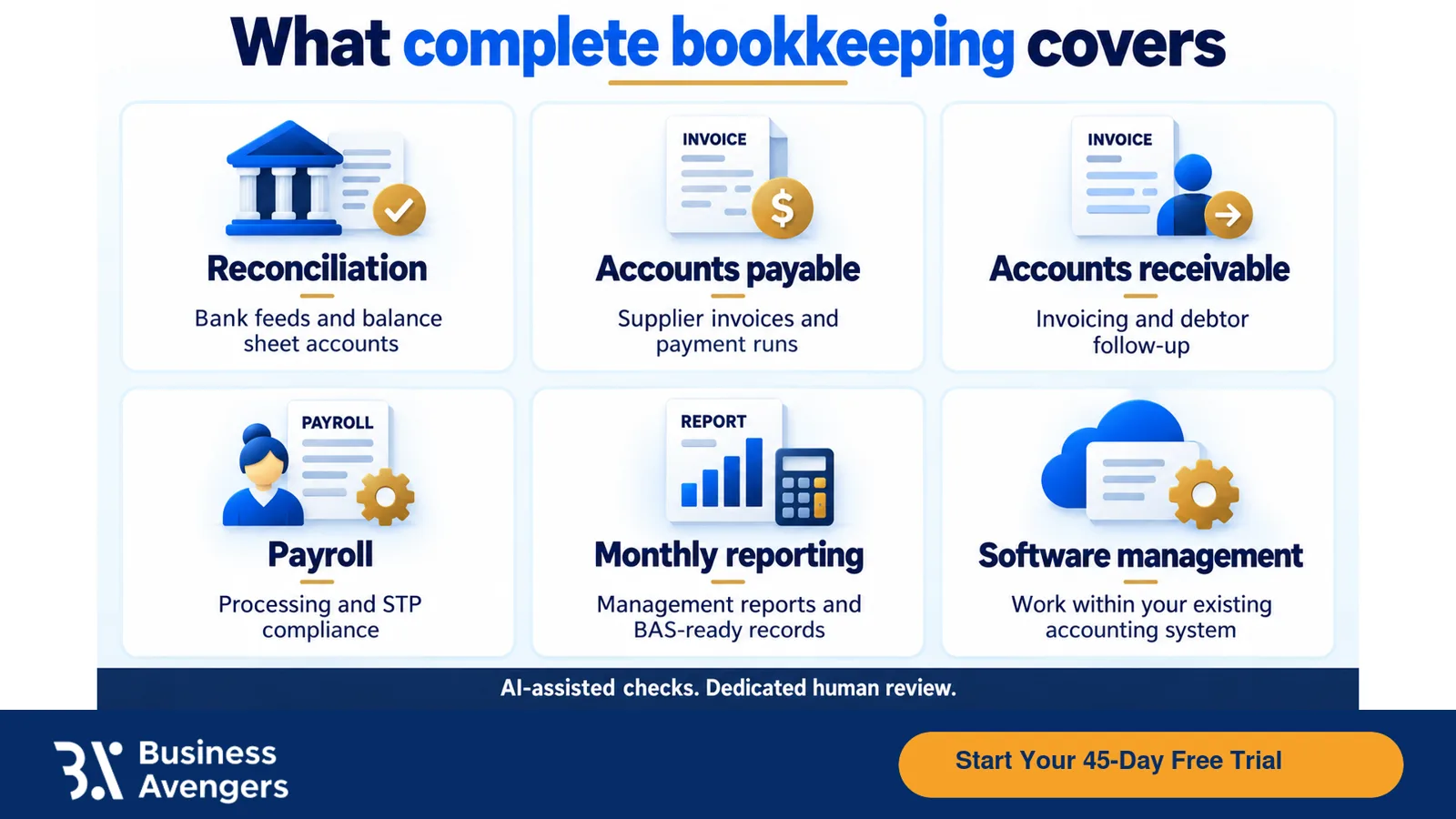
At a solid provider, outsourced bookkeeping services go well beyond basic data entry. Business Avengers' own bookkeeping service covers the full stack, and a genuinely complete engagement typically includes bank feed reconciliation and bank or balance sheet reconciliations, accounts payable processing and supplier payment runs, accounts receivable, invoicing and debtor follow-up, payroll processing and STP compliance, monthly management reports and reconciled records, and software management inside Xero, MYOB, QuickBooks, or NetSuite. The difference between a basic bookkeeping service and a genuinely useful one usually comes down to whether it's reactive (you chase them for reports) or proactive (they flag issues before you ask). If you're not sure which camp your current setup falls into, our small business bookkeeping checklist is a quick way to audit it yourself.
Outsourced Bookkeeping vs. a Local Bookkeeper: What's the Real Difference?
This is the comparison most businesses actually need to make, and we've written a full breakdown of it in Business Avengers vs. using a local bookkeeper. The short version: a single local bookkeeper is a single point of failure. If they're sick, on leave, or leave the role, your books stall. A dedicated outsourced team gives you redundancy, broader expertise, and, increasingly, AI-assisted checks that catch errors a single person might miss.
Common Bookkeeping Mistakes This Fixes
A lot of what pushes businesses toward outsourcing isn't a dramatic failure, it's an accumulation of small, avoidable errors. We see the same patterns repeatedly and have catalogued the most common bookkeeping mistakes Australian SMEs make: misclassified expenses, unreconciled accounts sitting for months, and manual payroll errors that turn into compliance headaches. If any of that sounds familiar, it's less about finding a "better" bookkeeper and more about finding a system that catches errors structurally rather than relying on one person to never miss anything.
What's Changed in 2026: AI-Assisted Bookkeeping
This is worth flagging because it's changing the cost equation. Reconciliation matching, invoice coding, and anomaly detection that used to eat hours of a bookkeeper's week can now be automated and simply reviewed by a human. The practical upshot for you: providers running AI-assisted workflows, like Business Avengers' Becide platform, can offer more senior attention on your books for less, because the repetitive 80% is handled by software and reviewed rather than manually redone every month.
How Much Do Outsourced Bookkeeping Services Cost in Australia?
Pricing depends on transaction volume, number of bank accounts, payroll headcount, and whether you need AP/AR on top of core bookkeeping. Rather than quote an unsourced industry-wide percentage saving, it's more honest to point to a real worked example: our in-house vs outsourced cost comparison walks through a fully-loaded in-house bookkeeping and AP/AR function costing roughly $196,000 a year against an equivalent outsourced team at $65,000 to $85,000. For a number specific to your business, Business Avengers' ROI calculator is a faster way to get there than guessing from industry averages. Transparent, no-hidden-fee pricing is worth insisting on. If a provider won't give you a clear scope and price before you sign, treat that as a red flag, not a quirk.
What to Look for in a Provider
- Dedicated team, not a shared pool. Ask directly: will I have the same people each week?
- Software compatibility. They should work inside your existing system, not force a migration.
- A trial period. Business Avengers offers a 45-day risk-free trial specifically so you can see the quality of the work before committing.
- Fast onboarding. Up and running within one week with a mature onboarding process.
- A path to more than bookkeeping. As you grow, you'll likely want CFO advisory or financial modelling, so it's worth choosing a provider that can grow with you rather than needing a second vendor later.
The Bottom Line
Outsourced bookkeeping services aren't about replacing a person with a cheaper person. They're about replacing a single point of failure with a dedicated, AI-supported team that catches problems before they compound. If your books have outgrown what one part-time bookkeeper can reliably manage, it's worth testing the alternative. Start with the 45-day risk-free trial or talk to us directly about your current setup.
Is outsourced bookkeeping suitable for a business with complex payroll or multiple entities?
How is outsourced bookkeeping priced, hourly or fixed fee?
Will an outsourced bookkeeper replace my accountant?
How long does it take to switch to an outsourced bookkeeping service?
What if I'm not happy with the service after switching?
Want to talk any of this through with a finance leader who has run these functions?
Was this article helpful?

Dilip Kherajani
CPA, Australia and Financial Strategist
20+ years of experience in Finance across multiple industries and geographies, 10+ of them as a CFO.