Rolling Forecast vs Budget: Which One Helps You Avoid Cash Shortfalls?
Over the past 12 months, nearly eight in ten Australian businesses have felt a cash flow squeeze, according to CommBank’s survey. This statistic serves as a reminder that if four out of five peers are scrambling for liquidity, relying on a once-a-year budget might look risky.
Your traditional budget locks in revenue and cost assumptions that you approved last June, before the cash rate increased and before the super guarantee rises to 12% on July 1, 2025.
In this blog, you will see two tools put head-to-head for scope, cadence, accuracy, compliance comfort, then walk away with a CFO-ready roadmap: how to bolt a rolling model onto your existing budget, stress-test it against the 2025-26 rule tweaks, and walk into the next board meeting with cash contingencies already costed.
What is a Traditional Budget?
A traditional budget is your twelve-month playbook, locked in at year-start to satisfy ASIC, reassure your bank manager, and nail down departmental spending.
1. Definition & Legal Role
Under section 286 of the Corporations Act 2001, you must keep financial records that “accurately explain” transactions and position the company to prepare true-and-fair statements. Most lenders incorporate this requirement into credit covenants, asking for a board-approved annual budget before renewing overdraft limits or extending term debt.
An annual budget is more than an internal planning tool; it’s part of your statutory compliance armour and your funding negotiation kit.
2. Key Compliance Dates
*If the due date falls on a weekend or public holiday, you lodge and pay on the next business day.
3. Rate-Lock Risk at 3.85 %
When you fixed this year’s budget, you probably set interest expenses at the Reserve Bank cash-rate corridor of roughly 3.85%. That assumption delivers certainty for grant applications and government tenders, but many require a static, board-endorsed forecast.
The downside? If the RBA trims rates again (or if you refinance at a lower margin), your budget can overstate funding costs and mask surplus capacity. Conversely, a surprise rate hike leaves you scrambling to explain interest overruns at the next board meeting.
What is a Rolling Forecast?
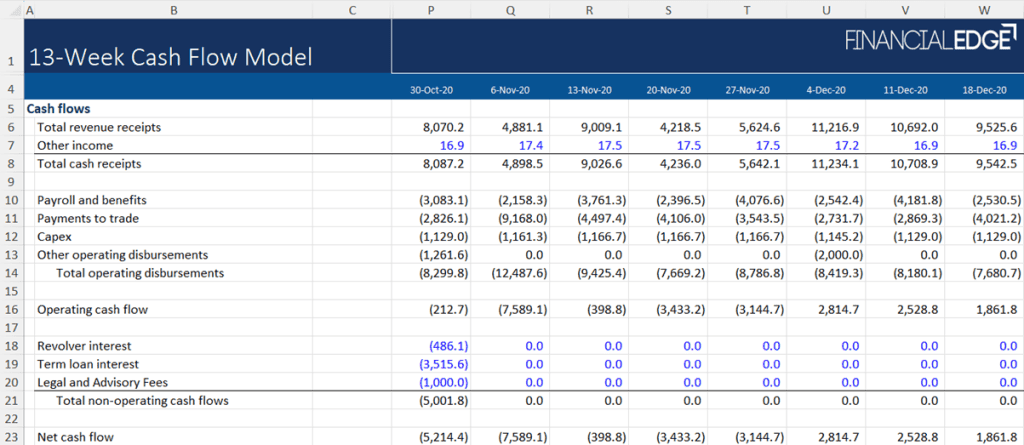
A rolling forecast is your live 13-week cash model, refreshed every month so you trade on today’s facts, not last July’s guesses.
1. Definition
A rolling forecast is a real-time financial tool that updates your projections based on actual data, typically over a 13-week horizon. It automatically extends forward with new data, adjusting assumptions like interest rates, sales, and operating costs.
For example, if a 25 basis-point (bp) increase in the cash rate is expected, the rolling forecast immediately adjusts the interest expense line. This gives you the ability to make informed decisions and preempt liquidity gaps before they hit your P&L.
Side-by-Side Comparison of Rolling Forecast vs Budget
Use this matrix to see, at a glance, where your annual budget keeps spending in check and where a 13-week rolling forecast shields you from sudden cash shocks. Learn how accurate cash flow forecasting can improve both rolling and traditional budgeting processes.
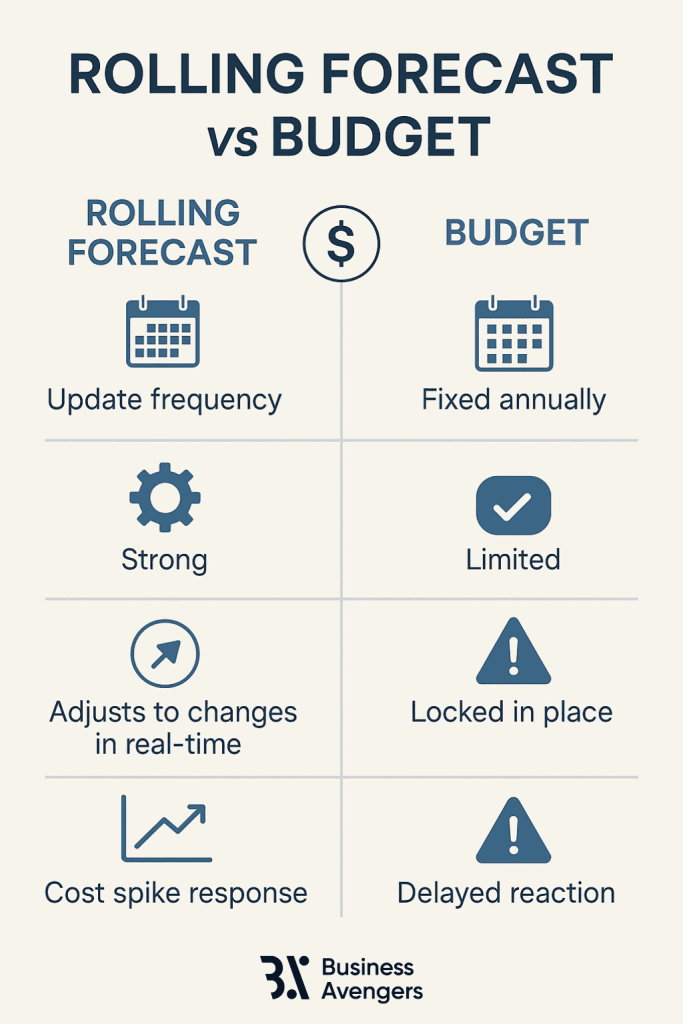
1. Flexibility vs Cost Control Discipline
Choosing a hybrid playbook: most mid-market firms keep a board-approved budget for compliance, then layer a rolling forecast over variable lines to protect working capital, giving you the best of both worlds in the rolling forecast vs traditional budget debate. A sound CFO financial strategy includes both rolling forecasts and performance-based budgeting.
- Budget strength: it locks spend, satisfies auditors, and keeps lenders comfortable.
- Rolling-forecast strength: it allows you to retool OPEX (operating expenses for day-to-day spending) within a week. Crucial when freight, FX, or wages jump.
2. Planning Horizon & Update Cadence
A rolling forecast keeps your financial visibility on a constant 13-week window. Unlike a traditional budget, which locks in projections for the entire year and is only revisited annually (or with rare revisions), the rolling forecast updates continuously to reflect the most recent actual results.
However, by rolling forward the forecast every month or week, you are always in tune with the latest trends in your cash flow. This allows you to forecast any future cash dips and take proactive steps, such as adjusting account payables, accelerating receivables, or securing credit lines.
3. Accuracy During Volatility
When volatility hits, whether it’s a sudden CPI (Consumer Price Index) spike or an unexpected cyclone-related supply shock, traditional budgets can quickly lose relevance. By the time the budget variances show up in your reports, the damage to cash flow might already have been done.
When you continuously update your rolling forecast financial model, you ensure that your business remains aligned with current influences. For example, if cash inflation surges or a supply chain crisis occurs, a rolling forecast allows you to adjust effectively and understand the immediate impact on finances.
4. Assumptions & Data Sources
The traditional budget only shows discrepancies at the month or year-end, forcing you to explain issues after the fact. A rolling forecast highlights them instantly, providing you with a clear, timely warning.
A traditional budget is generally created using a top-down approach, where the board sets revenue targets, and departments apply fixed expense percentages to allocate funds for the upcoming year. You rely on broad narratives, such as interest rates, foreign exchange rates, and CPI remaining relatively constant within a small range of ±0.5 percentage points.
The inherent limitation of the budgeting method is explicit: as the months pass, the hopes you had from your budget become increasingly outdated.
In contrast, a rolling forecast uses driver-based assumptions, such as sales per head or debtor days, which allow you to forecast cash flow instantly. The model continuously integrates live data from platforms such as Xero, Futrli, or Power BI, enabling more accurate forecasting.
You must focus on key performance indicators (KPIs) that accurately reflect your business's performance. This gives you more granular control over your budget, especially when market conditions shift rapidly.
Pro Tip: Pay attention to debtor days as a leading indicator. If this figure increases from 30 days to 45 days, you can spot a cash flow issue six weeks earlier in your rolling forecast.
- Traditional Budget
- Rolling Forecast
5. Solvency & Early-Warning Tests
Under Section 588G of the Corporations Act 2001, directors must ensure there are reasonable grounds to believe the company is not trading while insolvent. This is where a rolling forecast serves as a vital risk-management instrument.
A traditional budget may fall short in terms of clarity regarding solvency risks. While the budget provides a snapshot based on estimates made months ago, a rolling forecast keeps you aligned with continuous updates that give you insights into your business’s liquidity gaps or cash-flow challenges that could trigger an insolvent trading risk.
For example, a rolling forecast monitors cash flows week-by-week, catching issues such as the current ratio slipping below 1.0 or negative operating cash flow persisting over two quarters. These are clear early-warning signals that allow you to take action before it becomes a financial crisis.
6. Technology & Cost
See what technology is required for budget and rolling forecast strategies.
A traditional budget often relies on tools such as Excel, which is cost-effective but requires significant manual updates to expenses, bills, and other relevant data. With no automation, the budgeting process can be prone to errors, time-consuming, and disconnected from real-time financial performance.
A rolling forecast requires API-integrated tools like Futrli, PlanGuru, or Power BI to pull live data from your ERP, bank feeds, and other finance systems. While the subscription costs for these tools may be higher, they provide significant efficiency gains.
- Traditional Budget
- Rolling Forecast
7. Team Skill & Process Change
Transitioning to a rolling forecast requires a shift from a “set and forget” approach to continuous, cross-functional collaboration and ongoing monitoring.
Upskill Tip: Consider sending analysts to specialised training, such as CPA-Australia’s Driver-Based Forecasting micro-course, to enhance their ability to create forecasts based on operational drivers rather than historical data.
- The traditional budget process is straightforward and often left to finance with minimal input from other departments. Once a year, the finance team creates a comprehensive budget and rarely revisits it until the next cycle. This “set-and-forget” approach means the forecast is generic, based on assumptions made months ago, and lacks any updates throughout the year.
- In contrast, a rolling forecast demands constant collaboration across sales, operations, and finance. These teams must meet fortnightly to adjust funds based on the latest data, whether it's changes in sales trends, customer behaviour, or supply chain levels.
8. Decision-Making Speed
A rolling forecast boosts accountability by replacing long approval cycles with scenario planning.
The decision-making process tied to a conventional budget can take weeks. Every change, such as adjusting spend or reallocating resources, must go through multiple layers of approval, whether that’s from the board or various departments.
With a rolling forecast, you operate on a faster strategy, allowing for immediate action. In a scenario-swap meeting that takes hours instead of weeks, key stakeholders review the estimates, discuss potential shifts, and implement changes almost immediately. This means you can adapt and execute changes by the next payroll cycle, ensuring you remain focused in fast-moving environments.
Example: A retailer used their rolling forecast to identify a dip in sales for a particular SKU. Within 48 hours, they adjusted their orders and slashed underperforming stock, thereby preventing a $ 120,000 overhang. That quick decision made all the difference, demonstrating how a rolling forecast enables fast and informed decision-making.
- Traditional Budget:
- Rolling Forecast
9. Compliance & Stakeholder Reporting
A traditional budget helps you satisfy your compliance obligations, particularly with ASIC record-keeping and annual bank reviews. However, it’s crucial to understand that while the rolling forecast doesn’t replace the statutory budget, it complements it.
This means that while you will still maintain a budget for compliance and audit purposes, you will also use the rolling forecast to ensure spontaneous results. For stakeholder reporting, a rolling forecast provides a more current view of the company’s financial position.
Pro tip: Use both! Maintain the annual budget for statutory purposes, while utilising the rolling forecast for ongoing management and reporting, to ensure all stakeholders are kept informed with timely data.
2025-26 Rule Changes That Tilts the Cash Flow Forecast Equation
A Cash Accounting Model Should Protect Your Budget, Not Just Allocate It
We have explored the critical differences between traditional budget vs rolling forecast, and why the latter offers the flexibility and foresight that a static budget simply can’t provide in today’s spontaneous business environment.
A rolling forecast isn’t just about making predictions; it’s about staying ahead of cash-flow gaps and ensuring your business remains solvent during uncertain times. At Business Avengers, we believe your financial planning model should protect your budget, not just allocate funds.
That’s why we specialise in building financial forecast models that allow you to maintain control and be financially fit to meet the change. Contact us today and build a cash flow forecast model that smoothens your finances.
Want to talk any of this through with a finance leader who has run these functions?
Was this article helpful?

Dilip Kherajani
CPA, Australia and Financial Strategist
20+ years of experience in Finance across multiple industries and geographies, 10+ of them as a CFO.