10 CFO Strategies for Boosting Profitability and Operational Efficiency in Australian Businesses
Kudos! The first number you checked today was not revenue or receivables. It was the diesel price, now 14 % higher than yesterday, after the Aussie dollar’s overnight stumble. That single line on your dashboard just wiped a chunk off this week’s margin.
It’s the sort of spike regulators have flagged as increasingly common when the AUD weakens against the US dollar, pushing local pump prices higher. Episodes like this explain why Deloitte’s latest Asia-Pacific CFO survey ranks revenue growth as the No. 1 priority for 83% of finance leaders, closely followed by cost control and productivity.
With margins under pressure from all sides, such as currency swings, input volatility, and inflationary shocks, CFOs can’t rely on reactive budgeting alone. They need proactive and strategic levers to stay ahead.
The 10 High-Impact CFO Strategies That Are Impacting Differently in 2025
Use these ten CFO financial strategies to turn 2025’s volatility into sustainable margin and cash-flow gains.
1. Use 13-Week Forecasts & Quick Working Capital Fixes
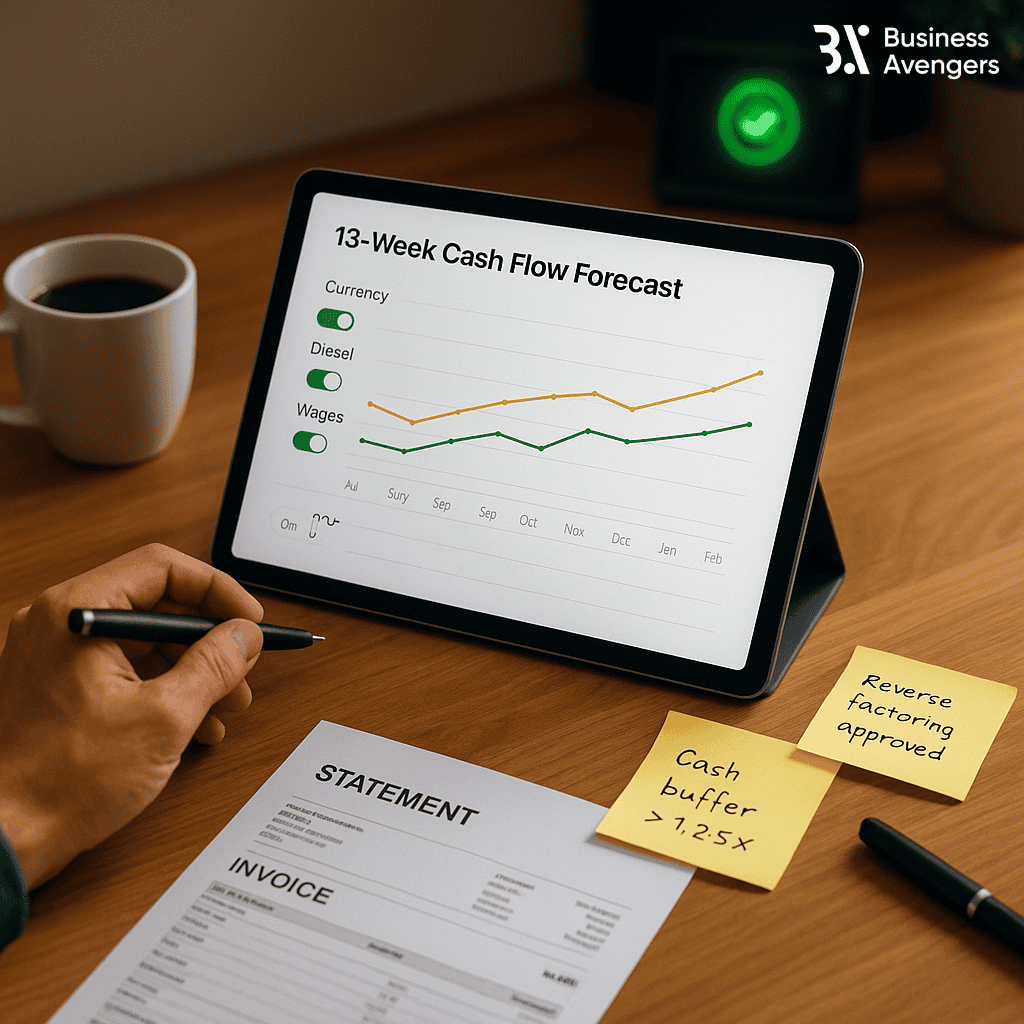
A 13-week rolling forecast gives you a real-time, week-by-week view that’s long enough to secure funding and short enough to act before cash dries up. Add simple fluctuation signs to your forecasting model (± AUD/USD swings, ± 75 bp RBA moves) so you can see how a market shock hits tomorrow’s balance.
What to do?
KPI , Operating-cash-flow coverage ratio: Hold it at ≥ 1.
- Every Friday, pull the latest bank and payroll feeds and roll your sheet forward one week so the horizon always covers 13 future weeks.
- If free cash drops below zero in any week, trigger a fix: early-pay supplier discounts, reverse factoring or dynamic-discount portals.
- Maintain a standing reverse-factoring line with your primary bank, allowing suppliers to be paid within 48 hours when the model turns red.
2. Use Zero-Based Cost Cuts
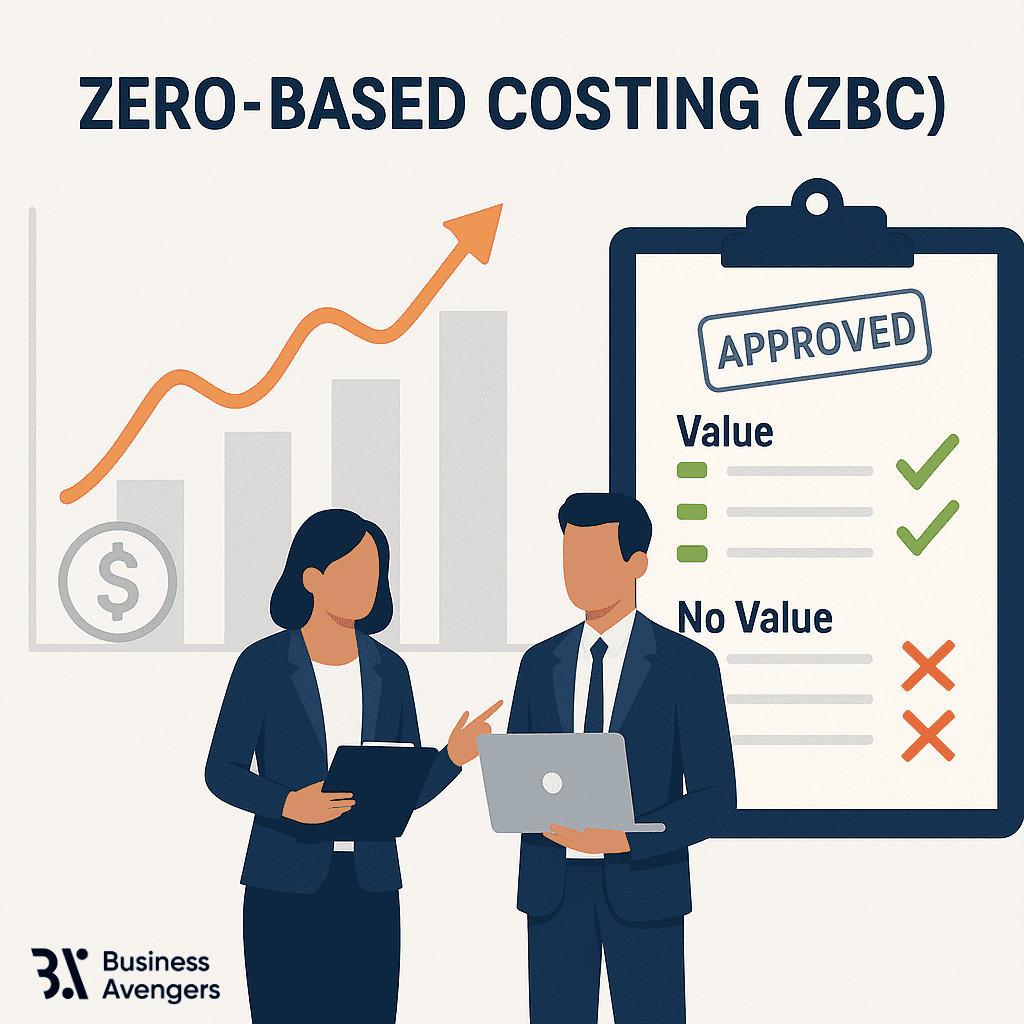
Labour-cost inflation is running 3.4 % year-on-year according to the latest ABS Wage Price Index, outpacing many mid-market revenue lines. A static budget that “rolls last year plus inflation” simply includes those rises.
Shift to zero-based costing (ZBC), where every department justifies every dollar from zero each quarter, and you expose sunk spend that no longer drives value.
What to do?
KPI , EBITDA margin lift vs. previous quarter — Watch EBITDA margin because it shows, almost immediately, whether the savings you cut actually hit profit. If the margin rises, the cuts stick; if it does not, money leaks back out.
- Week 1–2: Pull GL (general ledger) detail for payroll, freight, and SaaS seats. Highlight any cost line that rose faster than revenue in the last two quarters.
- Weeks 3–4: Challenge each cost: does it drive revenue or reduce risk? If not, mark it for cut or shrink.
- Weeks 5–8: Reset approved spend to only what survives the financial challenge.
- Weeks 9–12: Communicate new cost baselines to department heads and provide training on monitoring tools to ensure adoption and accountability.
3. Lock In Margins with Index-Linked Pricing
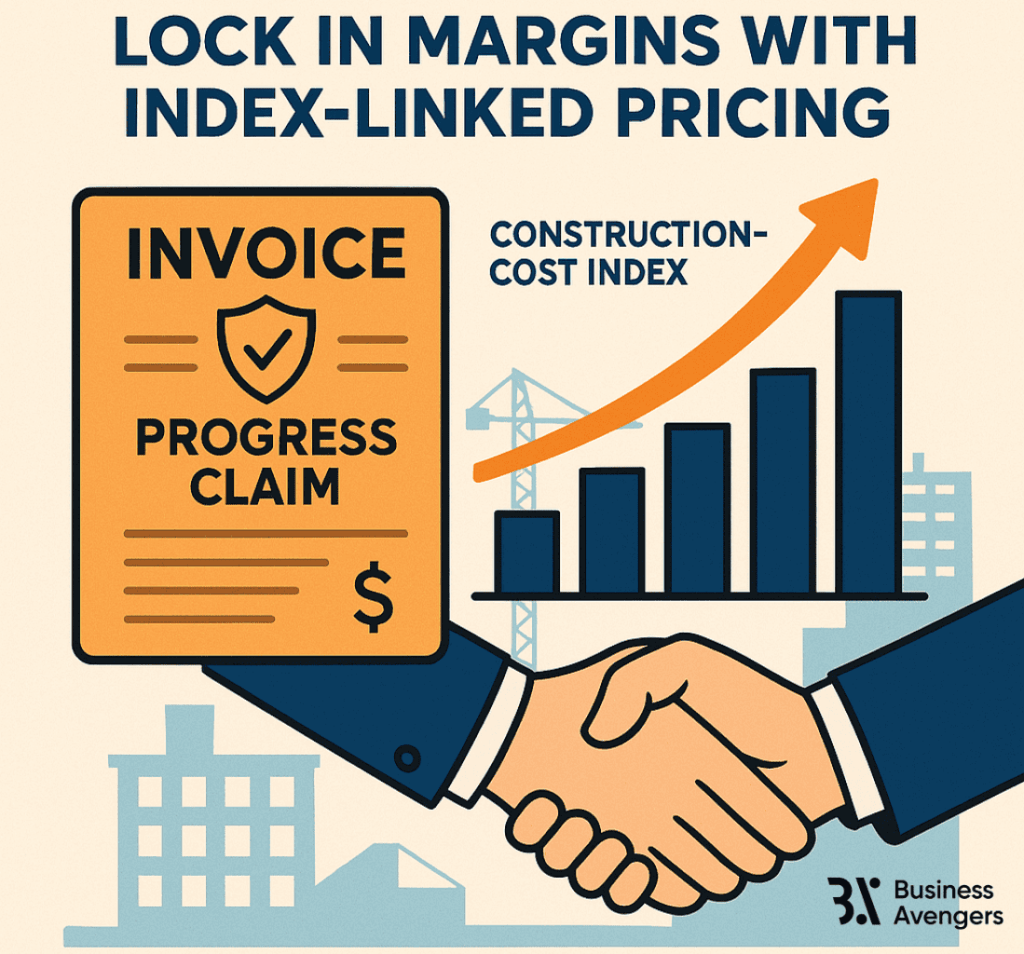
Rise-and-fall clauses add every progress payment to a published ABS construction-cost index. If that index jumps 3 %, your invoice jumps 3 % the same day, and cost inflation lands on the customer, not your gross margin.
What to do?
KPI: Gross-margin variance across all projects. Keep it inside ± 2 pp. If it drifts, the index is not covering your cost spike. Renegotiate the clause or apply a surcharge immediately.
- Western Australia already mandates this for jobs > 26 weeks, so suppliers and clients recognise the clause and won’t fight it.
- Suppliers agree to faster payment terms because the index shields them from surprise losses, shrinking your default risk.
- Add the clause. Pick the ABS “inputs to house construction” index (or similar) and write: “All labour and material rates adjust in line with quarterly movements in Index X, base date = contract signing.”
- Sync your ERP. Feed the latest index value into your billing engine so progress claims recalculate automatically.
- Monitor three signals: Contribution margin by project — alert if it swings ± 2 pp.
- Price elasticity by customer tier — if a 1% price bump cuts volume by more than 1.2%, review the surcharge.
- Key-account churn — trigger a retention offer if lost revenue tops 5 % QoQ.
4. Automate Finance Using P2P & O2C (and Gen-AI Bots)
This lag previously hindered SME cash flow.
What to do?
KPI , Drive Invoice-approval cycle time by ≥ 40 % within six months. Meeting this benchmark proves that a CFO's business strategies can boost automation in financial processes, alongside turning theory into cash.
- Procure-to-Pay (P2P) Auto-match purchase orders, goods-received notes, and supplier e-invoices in real time.
- Route exceptions to a Gen-AI bot that reads line-item context and flags only actual variances for human review.
- Order-to-Cash (O2C) Generate Peppol-compliant e-invoices straight from your ERP so customers can’t claim “missing fields” to delay payment.
- Let a conversational AI nudge late payers via WhatsApp. Eescalate to payment plan offers if no response is received.
- Reconciliations at machine speed Large Language Model-powered bots scan remittance advice and bank feeds, auto-tagging receipts to the correct AR ledger code in seconds.
Quarterly Review Process
- Week 1–2: Export the last quarter’s cap-ex and tech-spend lines. Auto-flag any item without an IAWO/Tech-Boost tag.
- Week 3: Compare live R&D ledger entries to the Australian Industry’s eligibility checklist. Patch gaps while lab notes are fresh.
6. Borrow Green, Save Green Using ESG-Linked Loans
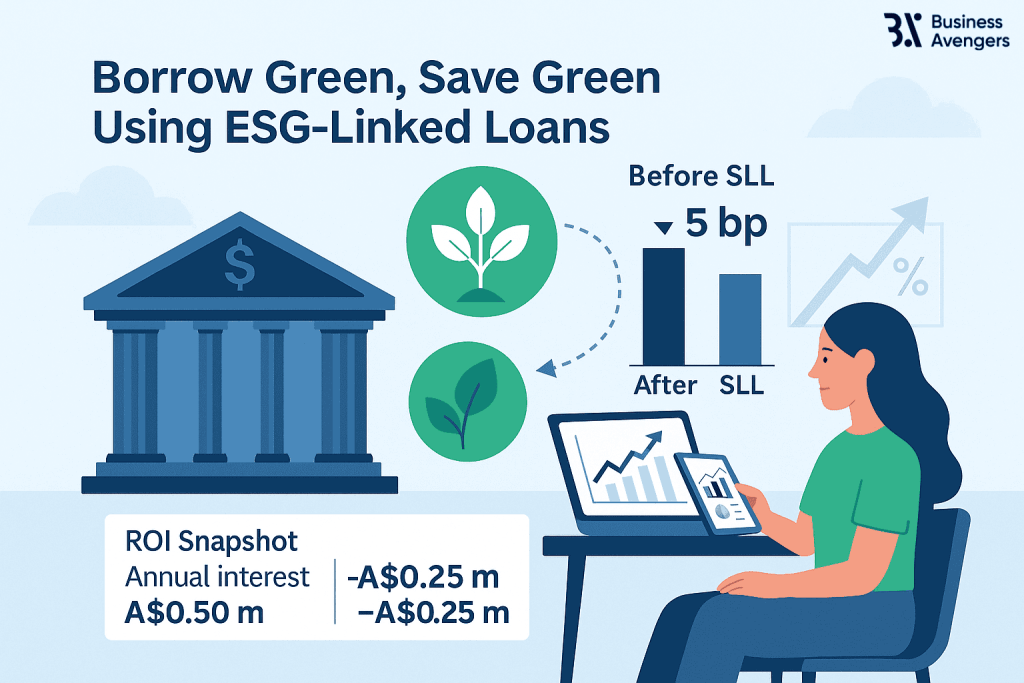
Sustainability-Linked Loans (SLLs) have evolved from a branding exercise to a practical tool for reducing the cost of capital.
- Why lenders care: ASIC’s 2024 climate-risk guidance warns banks to price transition risk explicitly. Deals that embed verified emissions targets attract lower capital weightings.
- What’s in it for you: Australian SLL margins typically step 5–7 basis points (bp) down when targets are met. Looks small on paper, but meaningful on an eight-figure debt.
- Real-world proof: Stockyard Beef closed a Rabobank-led SLL in Feb 2025, tying rates to methane-reduction KPIs and beating benchmark pricing.
ROI Example Snapshot (for SLLs)
BBSY = Bank Bill Swap Rate (standard AU floating benchmark). Assumes BBSY 2025 forward curve.
KPI: Interest-expense delta ≥ 5 bp at the first reset (12 months). Deliver that, and you can show the board a direct link between ESG goals and funding cost, precisely the kind of result high-impact CFO business strategies are expected to produce.
7. Plan Your Team with Data, Not Hunches
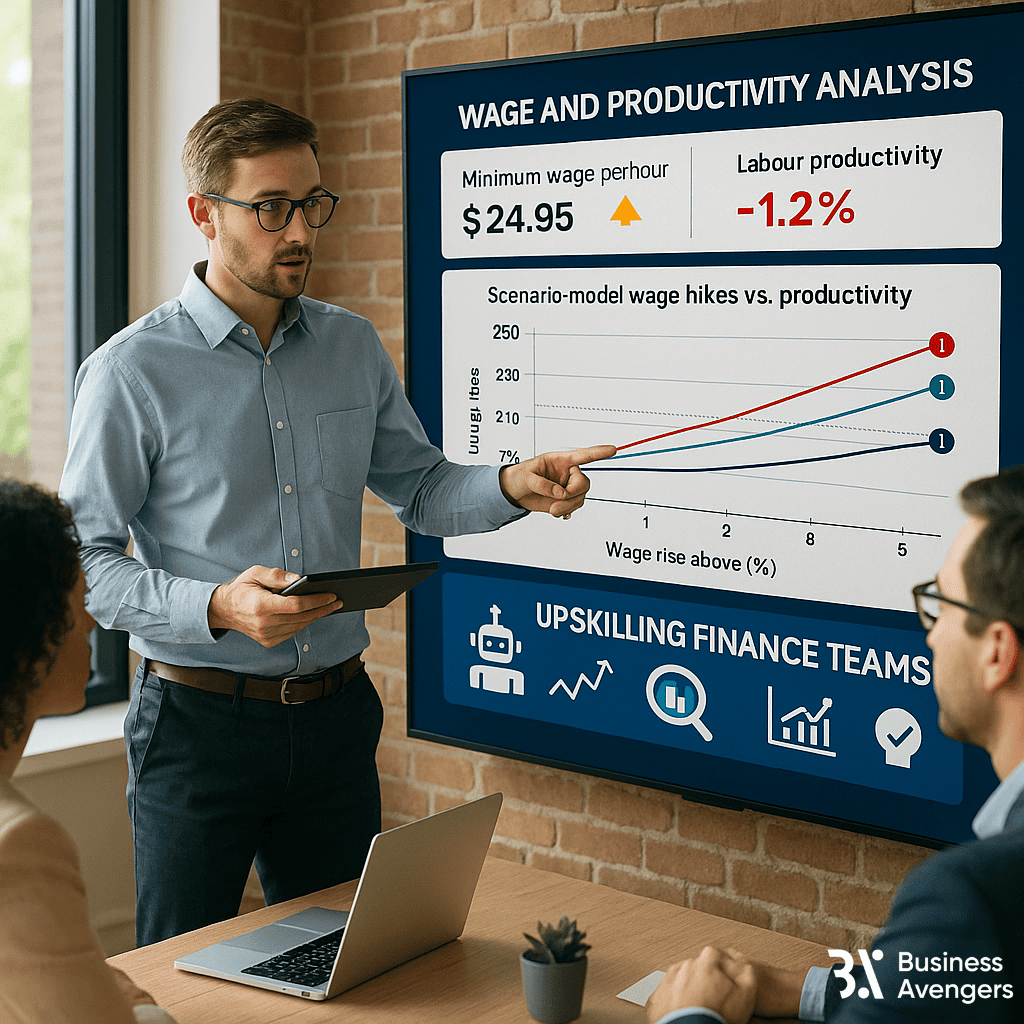
Australia’s minimum wage floor rises 3.5 % on 1 July 2025, up to A$24.95 an hour. At the same time, labour productivity fell 1.2 % year-on-year in Q1 2025, the fourth drop in five quarters. If you approve wages based only on CPI-plus budget, it might erode the margin.
What to do next?
KPI: Revenue per FTE should grow by ≥ 2 % a quarter once wage hikes are offset by higher automation. If it climbs, automation is outpacing wage inflation, and if not, revisit head-count plans or the scope of automation.
- Load Fair Work’s award tables into your 13-week forecast and add a wage-rise toggle (0 – 5 %).
- Overlay ABS productivity scenarios (flat, –1 %, +1 %) to see revenue-per-FTE (full-time equivalent) outcomes under each wage path.
- Trigger alerts when the model shows gross-margin compression > 2 pp for two consecutive weeks.
- Block half-days each quarter for staff to master invoice-automation bots or Power BI and tie those learnings to performance reviews. Higher automation is how you reverse the wage lift.
8. Grow Faster with Deals and Partnerships

Mid-market M&A is heating back up: Average disclosed mid-market deal size jumped to A$198.9 million in Q1 FY 2025, up 83 % year-on-year. Yet, Bain finds that only acquirers with disciplined playbooks outperform the market, delivering an 8.5% total shareholder return (TSR) versus 3.7% for their inactive peers over the past decade.
What helps?
KPI: Post-deal ROIC (Return on Invested Capital) after 12 months demonstrates that your CFO strategy captures value more quickly than market medians and maintains the acquisition's accretive nature.
- Run a quarterly readiness scan.
- Track value realisation monthly.
- Set ROIC ≥ WACC + 2 pp within 12 months of close.
- If actual ROIC slips by more than 1 pp, trigger a corrective integration sprint, cost alliance, cross-sell push, or asset disposals.
9. Hedge Your Risks for FX, Rates & Commodity Shields
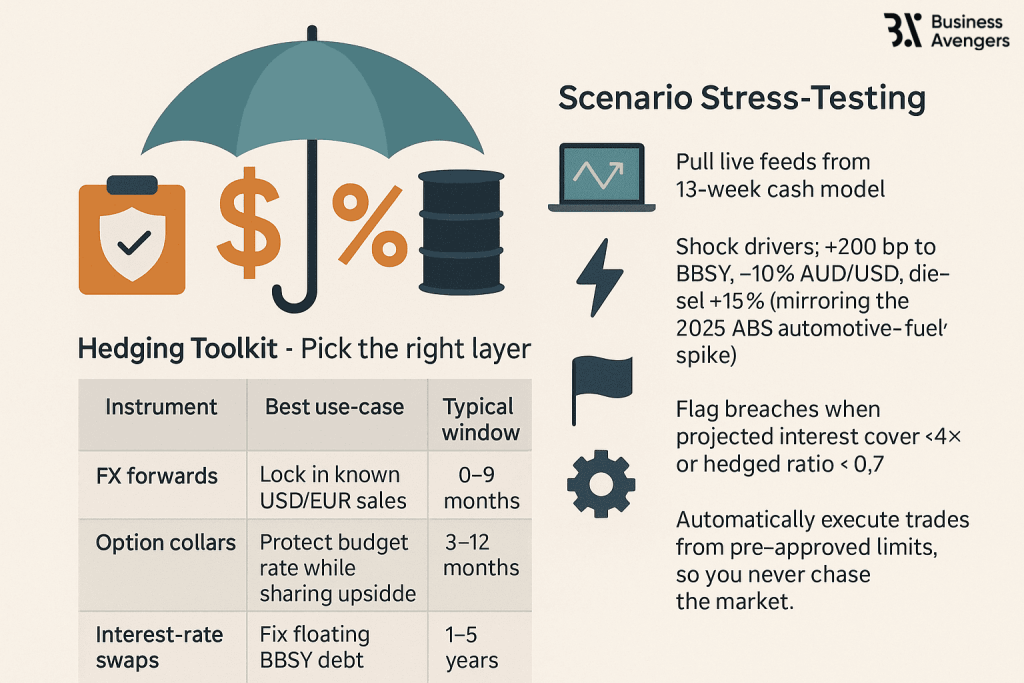
A 14 % diesel spike can wipe out a month’s margin, and a 200 bp jump in BBSY can double interest cost on floating debt. Top-quartile Australian exporters hedge about 70 % of six-month exposure, so price shocks land in the hedge book, not in EBITDA.
Which approach might help?
Layer your tools.
Stress-test weekly.
Pre-authorise execution.
KPI , Hedge-effectiveness ratio ≥ 0.8 (gain or loss on hedge ÷ unhedged exposure variance). Stay above that line and your strategy proves it can neutralise shocks before they hit the P&L.
- FX forwards for locked-in USD/EUR receipts up to nine months.
- Option collars provide budget protection while offering some upside (3–12 months).
- Interest-rate swaps to fix floating BBSY loans for one to five years.
- In your 13-week cash model, shock +200 bp BBSY, –10 % AUD/USD, diesel +15 %.
- Flag a red alert if interest cover dips below 4× or hedge ratio under 0.7.
- Maintain board-approved limits so the treasury can trade instantly, rather than chasing the market.
10. Drop Low-Margin Products & Clients
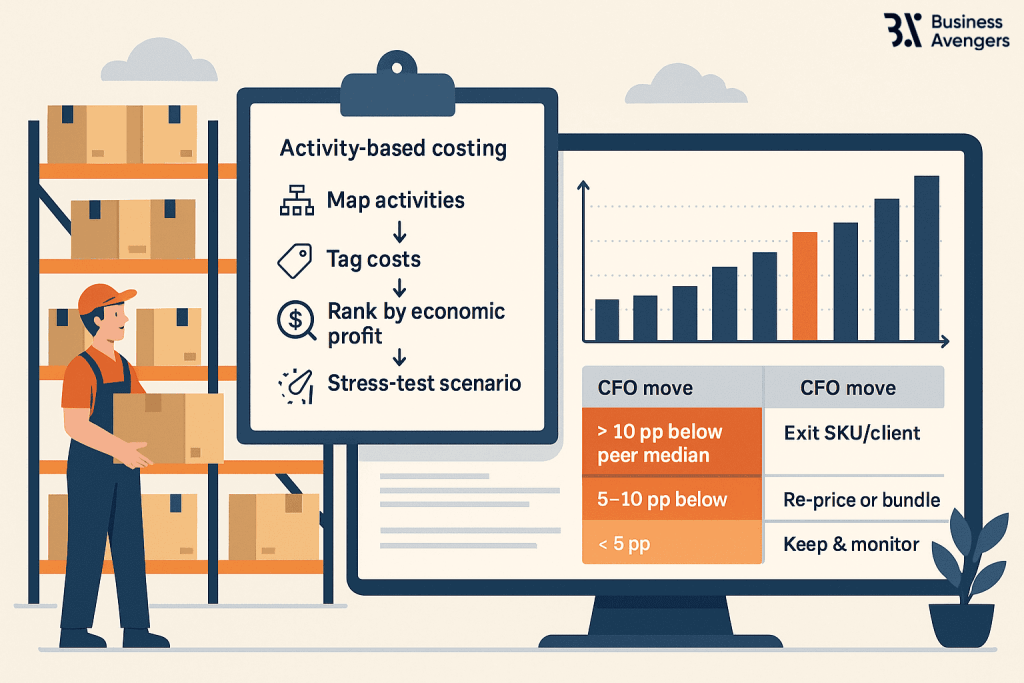
Bain’s 2025 consumer-products study finds that simplifying SKU (Stock Keeping Unit) portfolios lifts gross margin by 100–400 bp, roughly the 2–3 percentage-point EBIT bump your board craves. You won’t know what to cut until you see each SKU’s true cost-to-serve.
What to do?
Activity-based costing: a four-step sprint
- Map activities: order entry, pick-pack-ship, credit risk.
- Tag costs: allocate labour minutes, freight, and rebates to every SKU and client.
- Rank by economic profit: bottom decile = candidates for the axe.
- Stress-test scenario: if diesel climbs 10 % or wages rise 3.5 %, does the SKU stay above break-even?
Re-price, Bundle or Exit
KPI: Gross profit per SKU/client ↑ ≥ 10 % within 12 months. Hit that and you validate one of the most direct CFO strategies for margin expansion, a signature win to showcase in your next CFO business strategies board pack.
Turning CFO Strategies into Accountable Results
You have now pressure-tested 10 CFO strategies, from 13-week liquidity grids and rise-and-fall pricing clauses to ESG-linked funding and SKU rationalisation. Each comes with a hard KPI (cash-flow coverage ≥ 1.25×, gross-margin variance ≤ 2 pp, hedge-effectiveness ≥ 0.8, etc.).
When you lock those metrics into a single dashboard, you shift the role of finance from scorekeeping to continuous value creation: More cash, sooner, more substantial margins, lower risk, cheaper capital and growth on your terms.
If you can consistently report those wins, week in and week out, you will give the board the proof they need: that finance drives strategy, not just compliance. Business Avengers’ CFO Advisory service exists to ensure that accountability sticks. Contact us today!
Want to talk any of this through with a finance leader who has run these functions?
Was this article helpful?

Dilip Kherajani
CPA, Australia and Financial Strategist
20+ years of experience in Finance across multiple industries and geographies, 10+ of them as a CFO.