How the Australia Fuel Crisis Affects Your Business Finances — and What to Expect Next
A plain-English briefing for Australian CFOs, Finance Heads, and SME owners on the direct and indirect financial impacts of the 2026 fuel crisis — with the latest on the government's excise cut and what it really means for your costs.
If you run a business in Australia right now, you already feel it. Whether it shows up as a diesel invoice that made you blink twice, a freight surcharge notice buried in a supplier email, or a materials quote from your Brisbane builder that's suddenly 18% higher than last month — the Australia fuel crisis 2026 is not an abstract headline. It is landing directly in your accounts payable, your cash flow, and your quarterly P&L.
And for many Australian SMEs, the biggest risk is not the pump price itself — it is not knowing exactly where the financial exposure sits inside their business until it is too late to respond.
This guide exists to change that. We break down the three waves of fuel crisis impact on Australian businesses, explain what the government's excise cut actually means in practice for your cost base, identify which sectors carry the heaviest exposure in 2026, and give you a clear 90-day outlook to plan against — including the critical July 1 scenario every CFO needs to model right now.
Why Australia Is So Exposed to Fuel Shocks
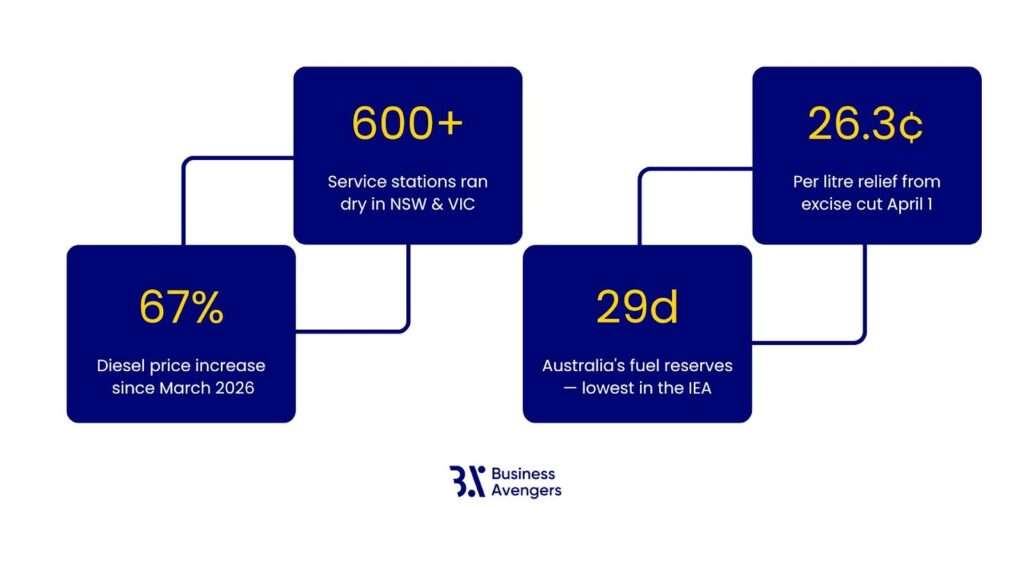
Before examining the fuel crisis impact on Australian business, it helps to understand why Australia is structurally more vulnerable to global supply disruptions than comparable economies. Australia imports approximately 90% of its refined petroleum products, maintaining just 29–36 days of supply at any given time — the lowest fuel reserve of any International Energy Agency member nation.
When the effective closure of the Strait of Hormuz disrupted approximately one fifth of global oil flows following the US-Israel conflict with Iran in early 2026, Australia's exposure was immediate. Unlike the United States or European Union, Australia has no meaningful strategic reserve buffer to absorb a multi-week supply interruption. The result was swift: diesel prices surged approximately 67% from the start of March 2026, and more than 600 service stations across New South Wales and Victoria ran out of at least one fuel type. United Petroleum — one of Australia's largest independent wholesalers — suspended customer allocations.
This is the baseline context for every financial impact that follows. The fuel shortage in NSW and VIC in 2026 was not simply a temporary distribution hiccup. It exposed a structural vulnerability in Australia's energy supply chain that businesses must now factor into their medium-term financial planning.
The Three Waves of Fuel Crisis Impact on Your Business
The most important insight for Australian business owners and CFOs is this: you do not need to run a fleet to feel the financial impact of rising fuel costs. Fuel cost is embedded in the price of almost everything through a cascade of effects that takes three to eight weeks to fully flow through to your supplier invoices and cost of goods. Here is how the three waves work.
Wave 1 — Direct Costs: Transport, Logistics, Construction, Agriculture
For businesses running vehicles, plant equipment, or generators, the impact of the diesel price increase in Australia 2026 is immediate and severe. Even after the government's excise cut from April 1, diesel will remain approximately 30–37% above its pre-crisis level of around $1.75 per litre. A transport operator running a modest fleet of ten trucks, each consuming 3,000 litres per month, is still facing a fuel cost increase of $40,000–$55,000 per month above their January 2026 baseline — even with the excise relief factored in.
For businesses managing transport logistics fuel costs in Sydney and other major metros, this is not a line item that can be absorbed quietly. It requires immediate attention from finance teams, including a review of fuel surcharge clauses in existing customer contracts and updated cash flow modelling for Q2 and Q3 2026.
For construction costs in Brisbane and Perth, the pain comes from multiple directions simultaneously: plant equipment fuel, concrete and steel delivery surcharges, and labour materials freight — all rising at the same time. Fixed-price contracts signed before March 2026 carry particular exposure here, and identifying these is a priority task for any construction business finance team right now.
Wave 2 — Freight Surcharges: Hitting Every Business With a Supplier
Even if you have no vehicles, no plant, and no direct fuel exposure, the freight surcharge impact in Australia in 2026 will show up in your accounts payable from April onwards. Most freight contracts include fuel surcharge mechanisms — but these were calibrated for normal price environments. At current elevated prices, surcharges are triggering at levels many businesses have never seen before.
Major freight operators including Toll, Linfox, and StarTrack flagged increases in late March. Australia Post has introduced higher fuel surcharges. The Housing Industry Association has warned that sustained fuel price increases could add $8,000–$15,000 to the cost of building a single new home. These costs flow through to retail prices and supplier invoices across every industry over a period of four to eight weeks — meaning much of the Wave 2 impact is still incoming as of the date of publication.
For SMEs managing tight accounts payable cycles, this is a critical monitoring task right now. Ask your bookkeeping team — whether in-house or outsourced bookkeeping in Australia — to flag every new surcharge or levy appearing on incoming supplier invoices and code them separately. The data you capture in April and May will be the basis for supplier renegotiation conversations in June.
Here we suggest: Action Point for Finance Teams
Set up a separate expense category in your accounting system for freight surcharges and fuel levies on supplier invoices. Logging these separately from base freight costs gives your management accounts the cost visibility needed to respond — rather than discovering the full impact at end of quarter.
Wave 3 — Inflation and Interest Rate Pressure
The third and broadest wave of the fuel crisis impact on Australian business is macroeconomic. Westpac forecasts headline CPI could reach 5.5% by mid-2026. The RBA rate rise business impact in 2026 is already real: the cash rate has been increased twice this year, reaching 4.10% in March, with further increases signalled as possible depending on how inflation evolves.
For any Australian SME carrying variable-rate debt — business loans, overdraft facilities, equipment finance — every basis point increase adds directly to monthly cash costs. The compounding effect of a sustained rate cycle on business cash flow during the fuel crisis is significant, particularly for businesses that established their debt structures during the low-rate years of 2020–2022 and have not reviewed them since.
The excise cut will reduce the direct fuel price inflation component. But supply chain cost increases already baked into freight contracts, supplier agreements, and raw material pricing will continue flowing through the economy for weeks after the bowser price drops. Do not assume that pump price relief translates immediately to supplier invoice relief.
What the Australia Fuel Excise Cut Actually Means for Your Business
The decision to halve the Australia fuel excise from April 2026 provides genuine relief at the pump — but its financial impact on businesses is more nuanced than the headline figure suggests. Here is what you need to know.
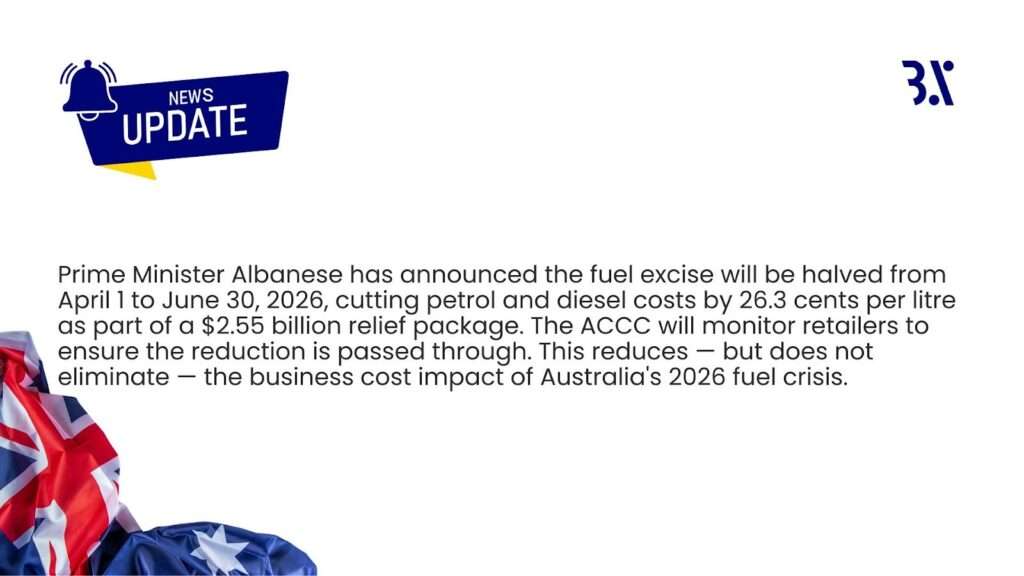
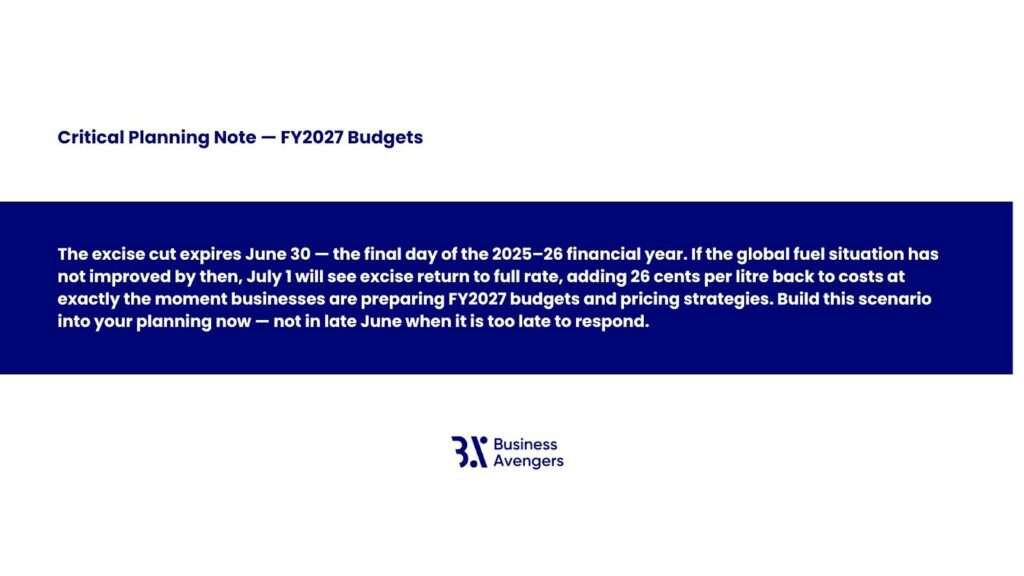
The critical planning point here: the Australia fuel excise halved in 2026 is a temporary measure with a hard expiry date of June 30. That date coincides with the last day of the 2025–26 financial year. If you are currently building your FY2027 budget, you need two scenarios: one where the cut is extended, and one where full excise returns on July 1 — potentially adding a second cost shock at exactly the moment businesses are most focused on annual planning.
Which Australian Businesses Face the Highest Financial Exposure
Let’s understand, while every business feels the fuel crisis through the supply chain cascade described above, that time certain sectors are experiencing direct, severe financial disruption that requires immediate intervention from finance teams.
Across all of these sectors, the common denominator is this: SME fuel cost management in Australia in 2026 is no longer just an operational question — it is a finance and cash flow management question. The businesses that get ahead of it will be the ones with current, accurate books that show them exactly where the exposure sits before it shows up as a missed payment or an overdrawn account.
What to Expect Over the Next 90 Days
The excise cut provides immediate pump relief, but the full financial story of the Australia fuel crisis will continue to evolve through Q2 and into Q3 2026. Here is a clear 90-day planning outlook for Australian CFOs, Finance Heads, and business owners.
April 2026 :
Excise cut takes effect April 1. Retail fuel prices should fall approximately 26 cents per litre within days. Monitor whether logistics providers and suppliers begin reducing surcharges — this typically lags by 2–4 weeks. Ensure your bookkeeping is current so you can track cost changes in real time.
April–May:
Supplier cost increases from March begin flowing fully into accounts payable. This is when the Wave 2 freight surcharge impact becomes most visible in your accounts. Ensure AP is processed promptly so your finance team sees current costs, not last month's delayed invoices.
May–June:
Working capital pressure peaks for businesses in affected industries as March cost increases hit payment terms. Debtor days may extend as customers in exposed sectors defer payment. Tighten AR management now — chase debtors earlier, and review customer credit terms for high-risk accounts.
July onwards +:
Excise returns to full rate unless the government extends the relief. If global supply has not stabilised, this creates a second cost shock at the start of FY2027. Build two scenarios into your annual budget: normalised supply with extended relief, and continued disruption with full excise restored.
The Finance Operations Response: What Your Team Needs to Do Now
Understanding the impact of the fuel crisis is one thing. Responding to it operationally is another. For Australian SMEs, the finance operations response centres on three capabilities: current visibility, rapid detection, and scenario-ready planning.
Current visibility means your books are up to date — not six weeks behind. When costs are moving as fast as they have since March 2026, management accounts that reflect last month's reality are worse than useless. They create false confidence. Outsourced bookkeeping in Australia that processes AP within 24 hours gives you the cost data you need to see what is happening in real time, not retrospectively.
Rapid detection means having the right expense categories and alert structures in place so that freight surcharges, fuel levies, and cost escalation notices are flagged when they arrive — not when they accumulate into a surprise at month-end. This is a simple setup task that pays significant dividends in a volatile cost environment.
Scenario-ready planning means having two models: a base case built on current costs and the excise cut continuing, and a stress case that models full excise restoration on July 1 with continued supply disruption. Both should be on the table in every board or leadership conversation between now and the end of June.
Final Thoughts
The Australia fuel crisis of 2026 is a genuinely significant economic disruption — not a short-term price spike that self-corrects in a few weeks. Even with the government's excise relief in place, Australian businesses across Sydney, Melbourne, Brisbane, and Perth are facing sustained cost increases through Q2 and Q3 that will show up in supplier invoices, freight charges, and working capital requirements long before they become obvious in your bank account.
The businesses that navigate this period best will not be the largest or the best-capitalised. They will be the ones whose finance teams have current, accurate books — so they can see the cost impact in real time, respond with current data, and make decisions before the damage arrives. That means knowing exactly what your freight costs look like today, not last month. It means modelling two FY2027 budget scenarios — not one. And it means having finance operations that are fast enough to match the speed of the environment.
At Business Avengers, we provide outsourced bookkeeping and accounting operations to Australian businesses that need exactly this: current books, rapid AP processing, proactive AR management, and management accounts that give your leadership team the cost visibility to respond — not react — to a rapidly changing environment. If the fuel crisis has exposed gaps in your financial visibility, now is the time to close them.
Book a quick review with Business Avengers!
Let's Talk Frequently Asked Questions (FAQs) 1. Does the fuel excise cut apply to diesel as well as petrol? Yes, the excise cut applies to both petrol and diesel. For businesses — particularly transport, agriculture, and construction — diesel is the more significant cost, so the relief applies directly to the fuel type with the highest business impact.
2. Your business does not use vehicles. Will you still feel the impact? Yes, even businesses with no direct fuel exposure will see rising costs through their supplier invoices — as freight surcharges, fuel levies, and cost escalation clauses flow through supply chains. The timeline is typically 4–8 weeks behind the pump price movement.
3. How do you track the fuel crisis impact on your business accounts? Ask your bookkeeping team to log every new surcharge or rate change on incoming supplier invoices. Code fuel surcharges to a separate expense category from base freight costs. This gives your management accounts the cost visibility needed to respond — rather than discovering the impact at the end of the quarter.
4. What happens to the excise cut after June 30? The current announcement runs from April 1 to June 30, 2026. The government has not committed to an extension. If global supply conditions have not stabilised, businesses should plan their FY2027 budgets with the assumption that full excise returns on July 1.
5. Should Australian SMEs consider outsourced bookkeeping to manage fuel crisis costs? Outsourced bookkeeping for Australian businesses offers a particular advantage in a volatile cost environment: it keeps accounts current and processed in near-real time, so finance leaders can see cost increases — including freight surcharges and fuel levies — as they arrive, not weeks later. When SME fuel costs and supply chain costs are moving as fast as they have in Q1 2026, management accounts that are six weeks behind are a genuine business risk. Current books are a crisis management tool, not just a compliance requirement.
6. What happens to fuel costs for Australian businesses after June 30, 2026? The government's current fuel excise cut runs from April 1 to June 30, 2026 only. No extension has been committed to. If global supply conditions have not stabilised — meaning the Strait of Hormuz disruption continues and Australian import volumes remain constrained — July 1 will see full excise restored, adding 26 cents per litre back to costs. Every Australian CFO should model this scenario into their FY2027 budget before the end of June.
7. How does the fuel shortage in NSW and VIC in 2026 affect business cash flow? The fuel shortage in NSW and VIC in 2026 creates business cash flow pressure through three channels simultaneously: higher direct fuel costs for operational fleets, freight surcharges on all incoming supplier goods, and broader supply chain cost inflation that reduces gross margins. Businesses with tight working capital — particularly SMEs in construction, retail, hospitality, and transport — face the highest cash flow risk and should review their cash position and credit facilities now.
Want to talk any of this through with a finance leader who has run these functions?
Was this article helpful?

Dilip Kherajani
CPA, Australia and Financial Strategist
20+ years of experience in Finance across multiple industries and geographies, 10+ of them as a CFO.