AI in Finance: Let’s Know How it Transforms the Future of the Finance Industry?
Artificial Intelligence (AI) is no longer a futuristic concept in the financial world — it’s the driving force reshaping how banks, fintechs, and financial institutions operate. The rise of AI in finance is transforming the way decisions are made, risks are managed, and customers are served.
From automating accounting workflows to enabling personalized banking experiences, artificial intelligence in finance is revolutionizing every corner of the financial sector.
In this article,let’s explore how Business Avengers experts improve financial automation with intelligent solutions.
Why Is AI in Finance Important?

AI in finance is important because it enhances decision-making, automates complex processes, improves accuracy, and helps financial institutions detect fraud, manage risks, and deliver personalized customer experiences efficiently.
Here we will understand the key point:
1. Data, Complexity & Speed: The New Reality
The finance industry generates vast amounts of data daily — transactions, trades, customer interactions, compliance reports, and more. Managing and interpreting this data manually is no longer sustainable.
That’s where finance artificial intelligence steps in. AI can process massive datasets at lightning speed, uncover patterns humans may miss, and make predictions with remarkable accuracy.
IBM describes artificial intelligence in finance as a way to analyze financial data, automate tasks, and improve decision-making. Unlike traditional rule-based software, AI continuously learns, adapts, and refines its outputs, ensuring more accurate and timely insights.
2. Staying Competitive in a Rapidly Evolving Market
Financial institutions adopting AI in financial services gain significant advantages — cost efficiency, faster operations, improved customer experience, and new revenue opportunities.
As Forbes highlights, AI is becoming a strategic lever for growth, not just an automation tool. It’s redefining how financial institutions create, deliver, and manage value.
3. Mitigating Risk and Enhancing Trust
In a highly regulated industry, compliance and trust are paramount. AI financial services help institutions detect anomalies, prevent fraud, and ensure adherence to complex regulations.
Through explainable AI (XAI) and transparent algorithms, financial organizations can ensure their systems remain ethical, traceable, and compliant.
In short: AI is no longer a choice — it’s a critical foundation for competitiveness and trust in the financial industry.
How Do Financial Institutions Use AI?
Financial institutions leverage AI for finance in various ways — from customer support to high-stakes trading. Below are the top real-world applications transforming the industry today.
1. Risk & Credit Assessment
Traditional credit scoring often fails to capture a borrower’s true risk profile. AI-powered credit models use diverse data sources — transaction history, spending behavior, and even mobile usage — to assess creditworthiness more accurately.
This approach enables fairer lending decisions and supports financial inclusion by serving those without conventional credit histories.
2. Fraud Detection & Anti-Money Laundering (AML)
AI in financial services is revolutionizing fraud detection. Machine learning algorithms detect unusual spending patterns or transaction behaviors in real-time — far faster and more accurately than human monitoring.
By learning from past incidents, AI systems reduce false positives while staying ahead of evolving threats.
3. Algorithmic & Quantitative Trading
Traders are increasingly turning to AI in finance industry for predictive analytics, trend detection, and real-time decision-making.
AI-based trading algorithms can analyze market data, forecast movements, and automatically execute trades — optimizing profitability while minimizing risk.
4. Robo-Advisory & Portfolio Management
AI-driven robo-advisors manage investments using sophisticated algorithms. They analyze market data and client goals to recommend personalized portfolios and rebalance them automatically.
This makes wealth management accessible to more people while maintaining precision and performance.
5. Customer Support & Chatbots
AI chatbots and virtual assistants streamline customer support by handling common queries, offering financial advice, and providing instant responses — 24/7.
These conversational systems learn from interactions to deliver increasingly personalized and efficient experiences.
6. Financial Process Automation
AI automates back-office finance tasks like:
By reducing manual effort, ai finance improves accuracy, saves time, and lowers costs — freeing finance teams to focus on strategy.
- Invoice processing
- Bank reconciliation
- Expense approvals
- Month-end closing
7. Compliance & Regulatory Monitoring
AI tools continuously scan regulatory updates, monitor transactions, and flag potential non-compliance risks. With explainable outputs, auditors can easily understand and verify AI-driven recommendations.
8. Embedded Finance & Smart Products
Through artificial intelligence finance, companies can integrate lending, insurance, or payment capabilities directly into their platforms.
Example: “Buy Now Pay Later” services that instantly evaluate customer eligibility — powered by AI risk models running in the background.
Benefits of AI in Finance
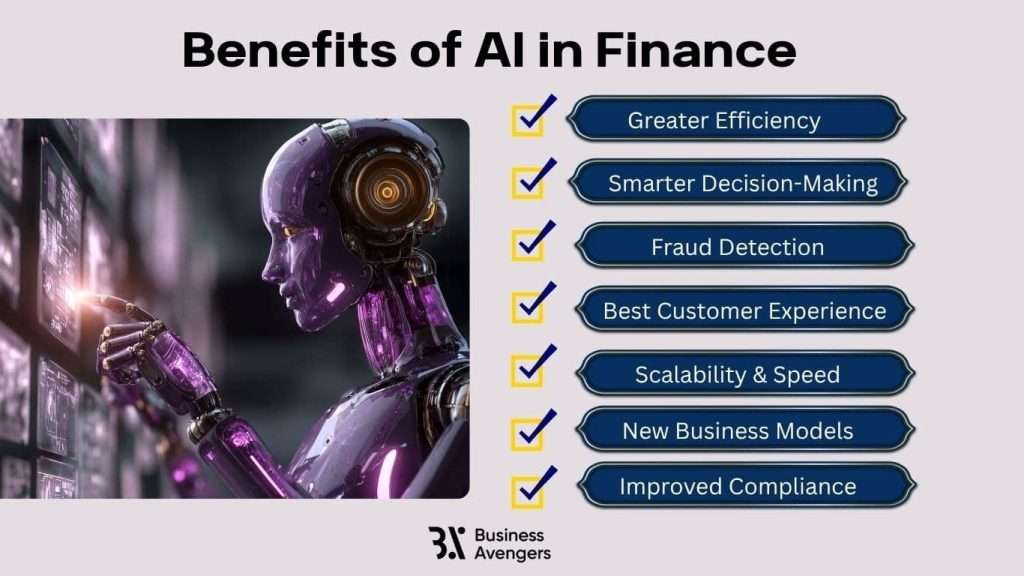
Before diving deeper, let’s explore the key benefits of AI in finance that are driving innovation and transforming how financial institutions operate.
1. Greater Efficiency & Cost Reduction
AI automates repetitive workflows, eliminating human error and reducing operational costs.
For instance, AI-based accounting automation can reduce invoice processing time by 25–40% and close financial periods faster.
2. Smarter Decision-Making
With advanced predictive analytics, institutions can make more informed decisions. AI identifies trends, forecasts market shifts, and simulates potential risks — helping leaders stay ahead of the curve.
3. Enhanced Fraud Detection & Risk Control
AI-driven systems detect suspicious activity in real-time, flagging threats before they cause damage. Financial institutions benefit from reduced fraud losses and improved compliance reporting.
4. Personalized Customer Experiences
AI financial services enable personalized product recommendations, dynamic interest rates, and financial coaching tailored to individual customers.
This not only boosts satisfaction but also deepens customer loyalty.
5. Scalability & Speed
Whether processing thousands of transactions per second or handling millions of customer queries, AI in finance scales effortlessly to meet growing demands without sacrificing quality or security.
6. New Business Models & Revenue Streams
From insurtech to real-time underwriting and algorithmic trading, AI unlocks innovative opportunities for monetization and market expansion.
7. Improved Compliance & Transparency
AI ensures financial decisions remain traceable, auditable, and compliant. Advanced explainability tools allow institutions to justify AI-generated outcomes to regulators and customers alike.
Future Trends in AI for Finance

The future of ai in finance industry looks even more exciting. Here are the key trends shaping what’s next:
1. Generative AI and AI Co-Pilots
Generative AI can draft reports, analyze documents, summarize contracts, and simulate market scenarios — saving analysts countless hours.
Soon, AI-powered co-pilots will assist financial teams in forecasting, budgeting, and decision-making in real time.
2. Explainable & Ethical AI
As AI adoption grows, so does the need for transparency. Explainable AI (XAI) helps institutions understand how decisions are made, ensuring fairness and accountability.
3. Privacy-Preserving AI & Federated Learning
AI systems will increasingly use privacy-first architectures that allow data collaboration without exposing sensitive information — a must for financial institutions handling confidential data.
4. AI at the Edge
Expect faster, real-time processing through edge computing. From instant loan approvals to real-time fraud checks, ai in finance will operate directly where data is generated.
5. Quantum Computing Meets Finance
Quantum-powered algorithms will soon revolutionize risk modelling, derivative pricing, and market simulation — further advancing artificial intelligence in finance.
6. AI-Driven Ecosystems & Embedded Finance
The future is interconnected. Financial services will seamlessly integrate with retail, e-commerce, and social platforms, powered by AI financial services and smart automation.
7. RegTech and SupTech Evolution
Regulators will also adopt AI to monitor compliance and detect systemic risks — ensuring safer, more transparent markets.
8. Democratization of AI Tools
Low-code and no-code AI platforms will make ai finance accessible to small banks, startups, and SMEs — fueling innovation beyond large enterprises.
9. AI for ESG & Climate Risk
AI will help analyze sustainability metrics, assess environmental risk, and guide ethical investments — aligning finance with global ESG goals.
How Is AI Making Finance Accessible to Everyone?
Beyond profits, ai in finance is a powerful driver of social and economic inclusion. Here’s how AI makes finance more accessible worldwide:
1. Alternative Data for Credit Scoring
AI leverages alternative data like mobile payments, e-commerce activity, and social behavior to assess creditworthiness — helping unbanked individuals gain access to financial products.
2. Affordable Digital Services
AI-powered mobile apps and chatbots bring financial services to rural or remote areas without costly infrastructure. This democratizes access to banking and microfinance.
3. Fraud Protection & Trust Building
AI safeguards users in developing regions where fraud risk is high, increasing public trust in digital finance systems.
4. Financial Education
Through AI assistants and gamified learning, users gain financial literacy, helping them save, invest, and borrow responsibly.
5. Localized Product Innovation
AI enables banks and fintechs to offer region-specific financial products — such as micro-insurance or flexible loans — that cater to local needs.
6. Partnership Ecosystems
Embedding ai financial services into telecoms, e-commerce, and fintech apps extends financial inclusion to millions of new users globally.
Financial Solutions with Automation by Business Avengers
At Business Avengers, we believe the future of finance is intelligent, automated, and human-centric.
Our financial solutions with automation empower businesses to smooth processes, reduce errors, and make smarter, data-driven decisions — powered by AI.
What we offer let’s understand this:
Whether you’re a startup, SME, or established financial institution, our tailored automation solutions help you stay agile and competitive in an AI-powered world.
- Automated Credit & Risk Management – AI-driven platforms that analyze risk and creditworthiness in real-time.
- Intelligent Accounting Automation – Streamline accounts payable, invoicing, and reconciliation through smart AI systems.
- AI Chatbots & Virtual Assistants – Provide personalized financial support and 24/7 customer engagement.
- Predictive Analytics for CFOs – Gain visibility into forecasts, cash flows, and cost trends through data-backed insights.
- Regulatory Compliance Automation – Stay audit-ready with explainable AI and transparent reporting.
- Embedded Finance Integration – Build scalable AI-driven financial services within your business ecosystem.
With the final thought
The integration of AI in finance is reshaping the financial landscape. From smarter decision-making to risk management and inclusion, AI’s potential is limitless.
As the financial world evolves, those who embrace artificial intelligence in finance today will lead tomorrow’s innovations.
At Business Avengers, we’re committed to helping businesses leverage automation and AI to create smarter, faster, and more inclusive financial systems.
Want to talk any of this through with a finance leader who has run these functions?
Was this article helpful?

Dilip Kherajani
CPA, Australia and Financial Strategist
20+ years of experience in Finance across multiple industries and geographies, 10+ of them as a CFO.