

Keeping your finances in check and building a well-structured budgeting and forecasting process is essential for Australian SMEs. It ensures that you regulate financial operations that align with ATO, maintain cash flow, and are based on economic scenarios.
Budgeting allows businesses to allocate funds logically, manage expenses, and liquidate assets to mitigate debts. Meanwhile, forecasting enables you to anticipate future financial conditions and adapt your business to market changes accordingly.
In this article, we will discuss the annual budgeting and forecasting process, helping SMEs build a resilient financial framework that supports sustainable growth and long-term success.
How Budgeting and Forecasting Process Boost Financial Health?

- A substantial budget and forecast process improves financial decision-making by providing a straightforward roadmap for income, expenses, and future business performance.
- With a clear budget, you can establish an optimised financial plan by setting fixed revenues, spending limits, and investment targets.
- This strategy helps control costs, meet profitability goals, and allocate resources wisely, including grants and funds.
- Additionally, forecasting enables your business to refine plans continuously based on evolving market conditions, ensuring adaptability.
A Step-by-Step Budget and Forecast Process for Australian Businesses
Developing a comprehensive budgeting and forecasting process is crucial for Australian SMEs’ financial stability and growth. Below is a detailed guide addressing each component involved in the process.
Your Budgeting Process Simplified
Financial management is essential, and simplifying your budgeting strategies can help you reduce the likelihood of errors. However, cash flow remains the most pressing concern for Australian SMEs in Victoria (43%) and NSW (38%). You can use the strategies suggested below to optimise your budgeting process.
1. Define the Period of Your Business Budget
Your financial team must ensure the period for which you want an accurate financial plan, including:
- SMEs with seasonal demand (e.g., retail, tourism) → Monthly or quarterly budgets
- Tech startups & service-based SMEs → Rolling 12-month forecasts
- Government-funded projects → Multi-year budget planning
The choice depends on the nature of your business, industry standards, and cash flow patterns. For example, a retail company with seasonal shifts may improve from monthly budgeting to closely monitor patterns in changing performance during high and low seasons.
Pro tip: Add insights from ATO on financial reporting standards specific to Australian enterprises.
Establish Current Financial Goals
2. Establish Current Financial Goals

Set Specific, Measurable, Achievable, Relevant, and Time-bound (SMART) goals during budget planning so that your business is in a considerable direction of meeting financial goals. For example, increasing monthly sales by 10% over the next quarter and reducing operational expenses by 5% for the next six months.
Well-defined financial goals help meet expenses, allocate funds according to desired profitability terms, and control overspending or unstrategic investment decisions.
3. Evaluate Your Financial Position and Gather Essential Data
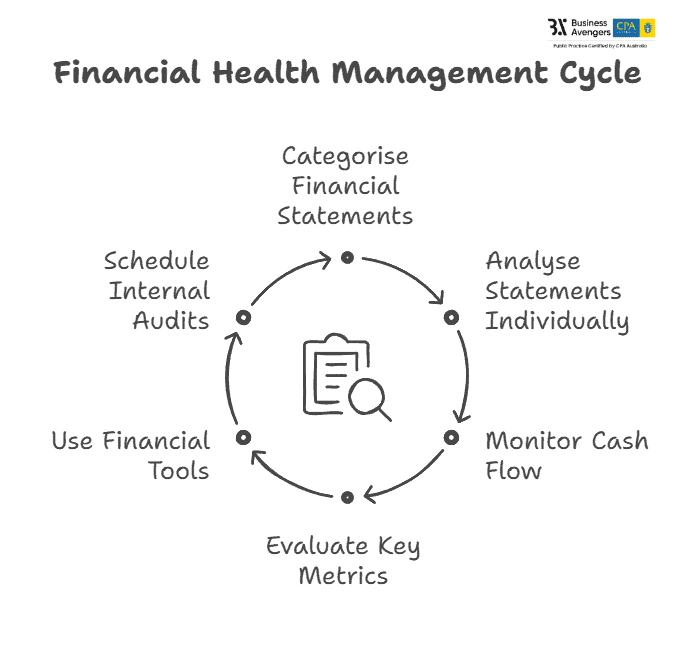
To gain a clear picture of your financial health, categorise financial statements and analyse each individually. Reviewing your balance sheet, income statement, and cash flow figures helps you assess assets, liabilities, revenue, and expenses in detail.
Monitor your operating cash flow to ensure you have enough liquidity to cover short-term obligations like debts or vendor payments. You can use tools like Xero, MYOB, and QuickBooks to improve financial oversight in your business.
Evaluate key metrics like net profit margins, gross profit margin, and return on investment (ROI) to measure profitability. Use cloud-based tools like Reckon and Sage to streamline financial record-keeping and automate transaction tracking.
Pro tip: Schedule internal audits to verify data accuracy and compliance with ATO regulations.
4. Identify Patterns in Revenue Streams
Gathering financial data can be overwhelming. You can start by reviewing past financial records and statements to examine sales trends, growth periods, and slow seasons. Once you know your peak sales time, you can strategically plan inventory, staffing, and marketing efforts, which can further help you anticipate customer purchasing behaviour.
These insights enable you to fine-tune pricing and promotions in response to your industry trends. Moreover, comparing your revenue patterns with industry competitors can offer insights into your current market standing.
Platforms like Google Analytics, Power BI, and Zoho Analytics help track revenue trends and identify areas of improvement.
5. Engage Stakeholders & Employees in Budgeting
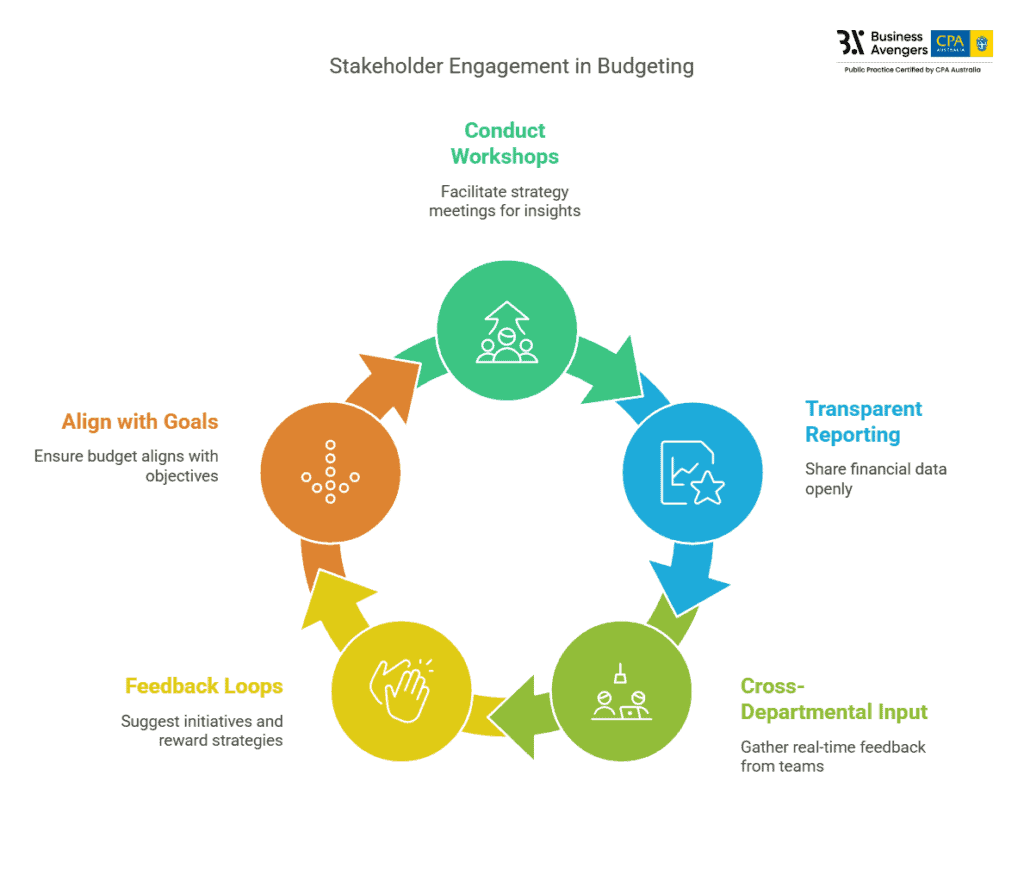
Engaging C-suite executives, department heads, and finance teams in budgeting and forecasting improves financial accuracy and optimises fund allocation. You can showcase the economic condition of your business to stakeholders, investors, and service providers using these insights to build trust.
Ways to Engage Stakeholders:
- Host Budgeting Workshops: Gather key team members to discuss cost management and revenue strategies.
- Ensure Financial Transparency: Share reports with leadership and employees to enhance accountability.
- Encourage Cross-Department Input: Sales, marketing, and operations teams provide real-time feedback.
- Implement Feedback Loops: Invite cost-saving suggestions and reward effective budgeting.
Motivate your employees to educate and guide your annual budgeting forecasting process. It helps you align your expenses with business goals.
6. Categorise Your Variable and Fixed Expenses
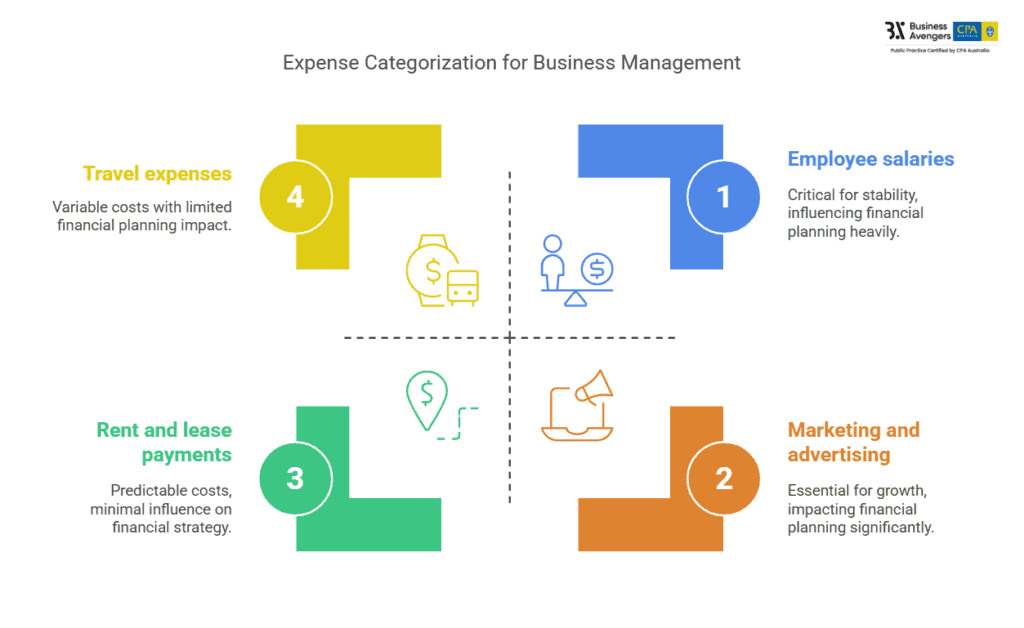
Understanding fixed and variable expenses clearly helps your business establish a neutral expense-to-revenue ratio. Fixed costs remain constant regardless of sales, while variable expenses fluctuate based on growth and business activity.
Fixed Expenses (Consistent Costs)
- Rent and lease payments
- Employee salaries (for full-time staff)
- Insurance and licenses
- Software subscriptions
- Loan repayments
Variable Expenses (Fluctuating Costs)
- Raw materials and inventory
- Utilities and energy costs
- Marketing and advertising
- Travel expenses
- Freelancer or contractor payments
Always establish a list of all the expenses you make for operational purposes in your budget document. Let’s discuss documenting your budget in detail in the next section.
7. Create Budget Document
A budget document helps your business track income and expenses, plan for contingencies, and suggest data-driven financial strategies. Include all revenue streams ranging from product and service sales to operational expansion expenditure and investment.
Categorise your expenses as fixed and variable to have better cost control and establish the objectives of your financial period. Allocate the budgets based on priority, but don’t forget to anticipate income using financial modelling techniques. You can use Google Sheets Budget Template to create budgets and get real-time updates.
8. Implement and Monitor the Budget
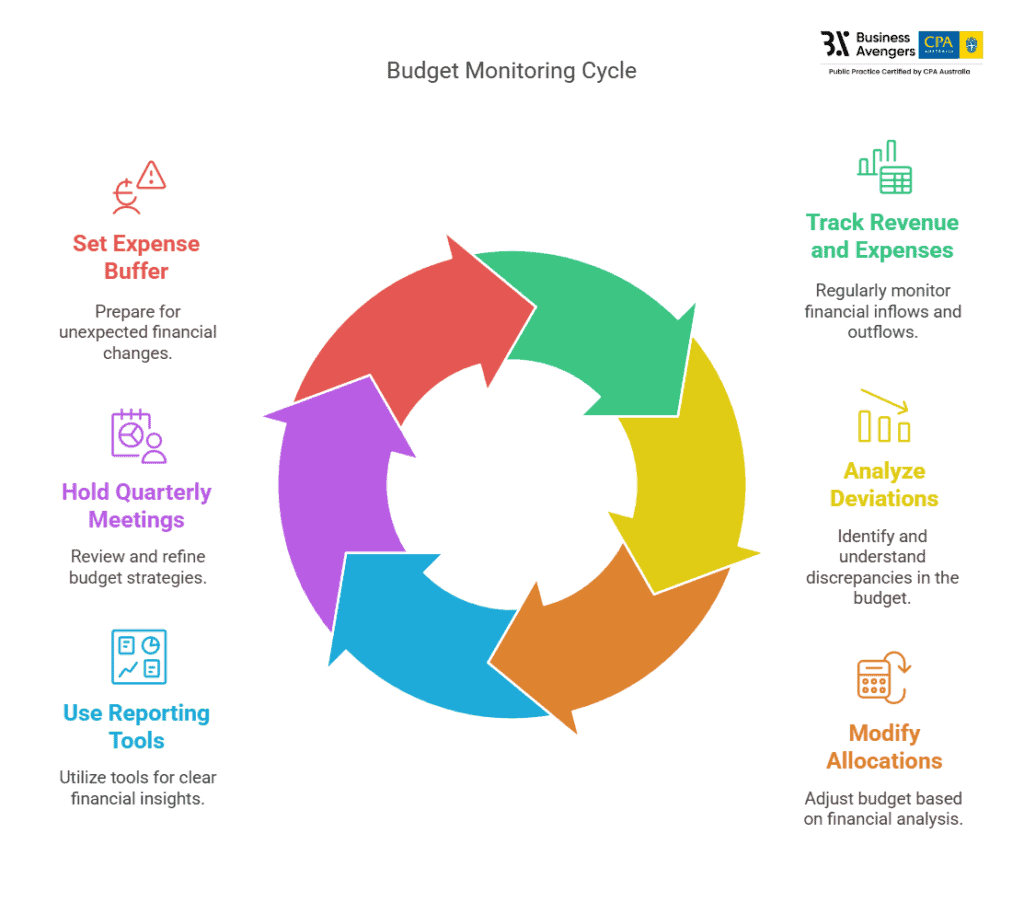
Budget implementation is an ongoing process that requires regular anticipation and a lot of patience to ensure the adjustments show financial success. Budget variance analysis helps businesses compare actual financial performance against projected figures.
How to monitor the budget effectively?
- Track monthly revenue and expenses.
- Analyse deviations
- Modify budget allocations
- Use Xero Reports to turn complex financial reporting into easy-to-read terms.
- Hold quarterly budget meetings.
Pro tip: Set a 5-10% buffer in your budget to accommodate unexpected expenses while maintaining financial stability.
Forecasting Process: Predict & Prepare For Market Changes
Financial forecasting is the backbone of a business’s economic landscape, offering comparative insights into evolving customer behaviour and technological requirements. The Australian payments market is projected to grow from USD 1.07 trillion in 2025 to USD 2.29 trillion by 2030, which means cash payment will no longer be a necessary mode of payment.
1. Choose Forecasting Methodology
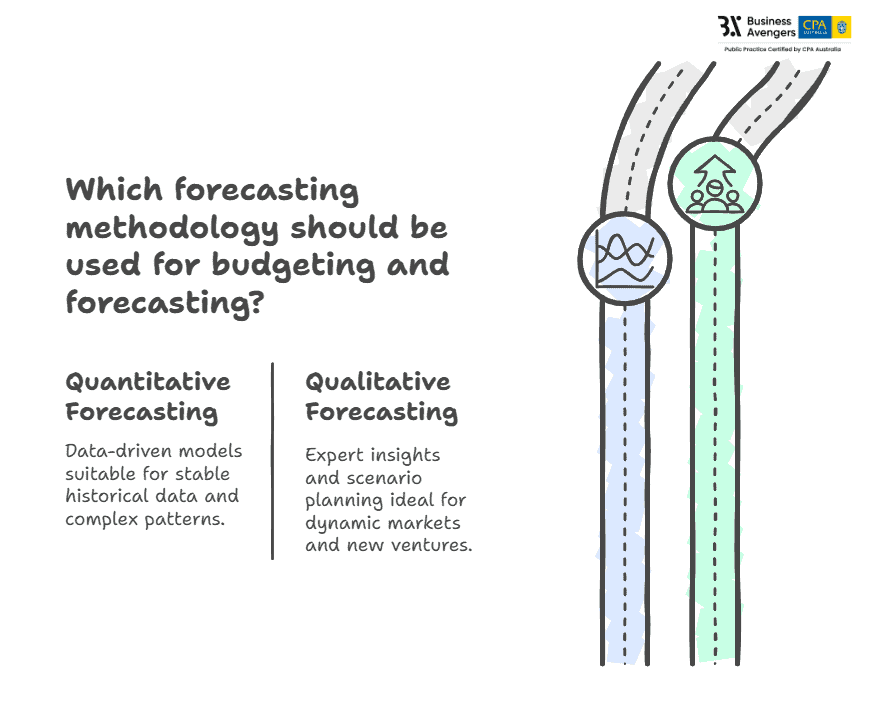
The budgeting and forecasting process steps must include AI-powered financial management, as Commonwealth Bank’s significant investment in AI shows a 40% reduction in call center wait times and a 50% decrease in scam losses.
Quantitative Forecasting (Data-Driven Models):
- Time Series Analysis: Suitable for businesses with stable historical data, such as manufacturing firms.
- Bayesian Forecasting: Incorporates probability distributions to update predictions dynamically based on new information. Ideal for dynamic industries like retail, logistics, and stock trading.
- Regression Analysis: Ideal for identifying relationships between variables, like sales revenue and marketing expenditure.
- Agent-Based Modeling (ABM): Simulates individual decision-makers (customers, suppliers) to forecast market behaviour.
- Financial Modeling: Incorporates comprehensive financial statements to project future scenarios (best-case/worst-case, financial statement and reporting, etc).
- AI-Driven Predictive Analytics: Understand larger datasets for e-commerce, fintech, or SaaS businesses using deep learning models to detect complex patterns in historical finances and market data.
Qualitative Forecasting (Expert Insights):
- Delphi Method: Gathers insights from industry experts to predict market trends.
- “What-if” Scenario Planning: Businesses develop multiple “what-if” scenarios for different economic conditions like inflation spikes, supply chain disruptions, or interest rate changes.
- Crowdsourced Forecasting: Uses real-time consumer and market sentiment data (via social media and surveys) to predict demand fluctuations.
- Market Research & Customer Feedback: Essential for startups entering new markets.
Pro tip: Use Natural Language Processing models to fetch insights from social media, news, and customer reviews for demand forecasting. Incorporate geopolitical risks, trade policies, and economic indicators for supply chain and financial risk planning.
2. Include Capital Expenditure (if any) to Your Forecast
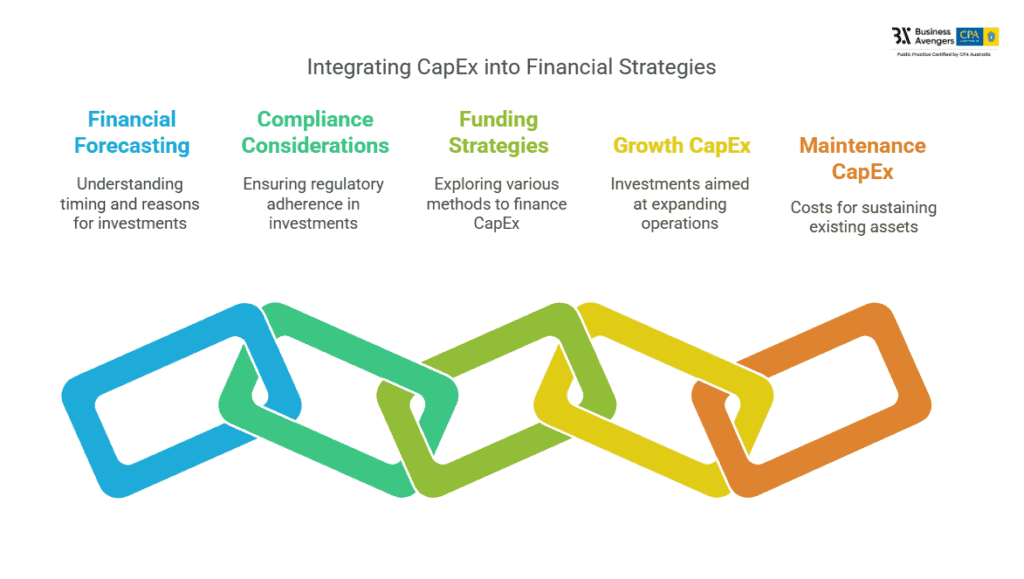
Unlike operational expenses (OpEx), which cover day-to-day costs, CapEx involves significant upfront spending that affects financial forecasting, budgeting, and tax planning. Also, notably, 52% of Australian businesses suggest maintaining their physical CapEx investments in 2025, while 27% intend to increase them.
How to integrate CapEx into financial forecasting?
- Understanding the “Why”: Ensure that investments are expansion-driven. For example, opening a new store or purchasing technology for better results.
- Understanding the “When”: Check for replacements in outdated assets. For example, upgrading IT infrastructure or transitioning to cloud-based ERP systems.
- Check for Australian Compliance: Evaluate if the investment is a part of a regulatory compliance requirement. For example, sustainability-driven upgrades for ESG reporting in Australia.
- Growth CapEx: Investments in new assets, technologies, or facilities to expand operations.
- Maintenance CapEx: Costs incurred to repair, upgrade, or sustain existing assets.
- Gather quotes from suppliers, contractors, and technology vendors to estimate upfront costs. Factor in hidden costs such as installation fees, licensing, and employee training.
- Consider phased investments to manage cash flow efficiently (e.g., upgrading equipment in stages rather than all at once).
Capital investments can be funded through retained earnings, evaluating loan options, leveraging ATO incentives like asset write-offs, or raising funds via investors and bonds.
3. Update with Your Latest Financial Data
Updated financial data showcases changes in market trends, economic conditions, and internal business performance. In 2025, Australian SMEs can use platforms like Thriday to integrate banking and accounting services, allowing businesses to track and categorise transactions automatically.
- Internal: Sales reports, operational costs, customer retention rates, and order fulfilment speed. Helps identify fluctuations in customer demand.
- External: Inflation trends, sector-specific growth projections, employment rates from ABS, and RBA economic updates to anticipate borrowing cost fluctuations.
- Cross-Check with Budgeted vs. Actual Figures: Variance analysis ensures projections align with financial realities. Use AI-driven platforms like Oracle NetSuite or IBM Planning Analytics to improve forecasting accuracy.
Pro tip: The Australian Bureau of Statistics (ABS) reported a projected 3.5% inflation rate for 2025, impacting pricing and supply chain costs. Data from IBISWorld or Deloitte SME Outlook can be used to compare financial performance with competitors.
Include Financial Metrics to Project Financial Behavior
4. Include Financial Metrics to Project Financial Behavior
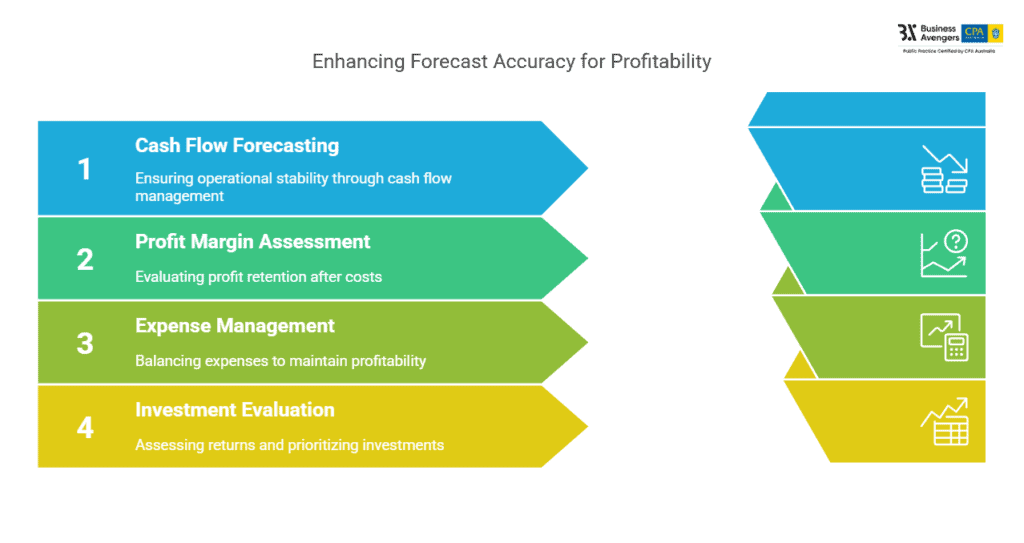
Inaccurate forecasts can lead to disintegrated profit expectations. Accurate forecasting relies on key financial metrics that track profitability, cash flow, and business sustainability.
- Cash Flow Forecasts: A positive cash flow ensures operational stability and avoids short-term financing issues. Use tools like Float App or Xero Cash Flow Planner to predict future cash inflows and outflows to prevent liquidity shortages.
- Profit Margins (Gross, Net, and EBITDA): Determines how much profit a business retains after costs. How to calculate- Gross Profit Margin = (Revenue – COGS) / Revenue × 100. (Here, COGS: Company’s cost of goods sold)
- Expense-to-Revenue Ratio: The Cost Revenue Ratio (CRR) or expense-to-revenue ratio measures your company’s operating expenses relative to its generated revenues. Its primary objective is to pinpoint potential excessive spending. Hence, CRR ensures your company generates more revenue than it allocates to its operations.
- Return on Investment (ROI): Evaluates the financial returns of business investments.
- Net Present Value (NPV): Assesses long-term profitability and investment value. It helps businesses prioritise high-value projects over risky investments.
Pro tip: Australian SMEs that track financial metrics using AI-powered dashboards see a 30% increase in forecasting accuracy.
5. Validate & Refine Forecasts
A well-planned forecast requires continuous validation and refinement, and the best way to ensure accuracy is through scenario and variance analysis.
Steps to Validate & Improve Financial Forecasts
- Perform Scenario Planning: Suggest best-case, worst-case, and expected outcomes. For example, How will revenue be impacted if the RBA increases interest rates by 1%? Use economic trend data from RBA and ABS to test multiple financial scenarios.
- Conduct Sensitivity Analysis: Tests how small changes (e.g., supply chain costs rising by 5%) impact overall profitability. Use tools like SAP Analytics Cloud or Power BI.
- Use Variance Analysis to Compare Forecast vs. Actuals: If an SME projected $500,000 in annual revenue but achieved $460,000, variance analysis explains why. Adjust forecasting models to reflect realistic market conditions.
Pro Tip: Use AI-driven forecasting platforms like IBM Cognos Analytics to automatically refine projections based on new market data.
6. Check for Factors that Influence Your Financial Efficiency
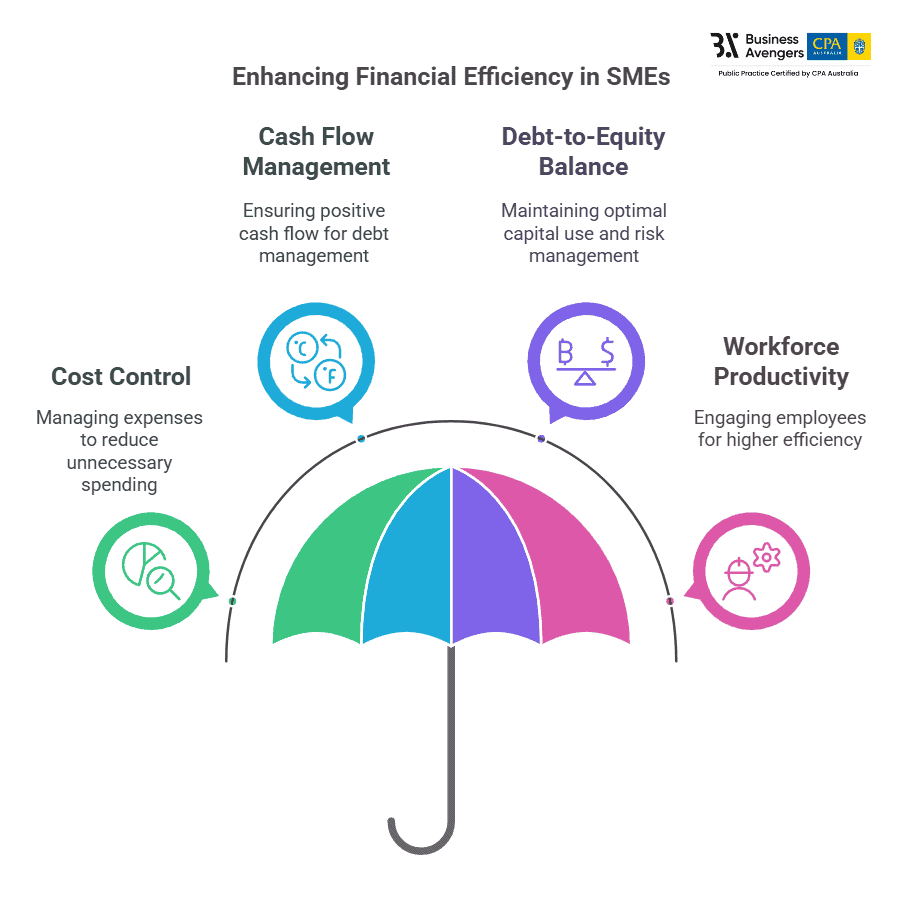
Did you know that business insolvencies have surged roughly around 40% compared to the pre-pandemic period? Given this rise, Australian SMEs must identify and address factors affecting financial efficiency.
- Cost Control & Expense Management: Reduce costs by renegotiating contracts, streamlining operations, and using expense-tracking tools.
- Cash Flow Management & Liquidity: Maintain positive cash flow with strict invoicing and short-term financial solutions.
- Debt-to-Equity Balance & Risk Management: Avoid excessive borrowing to reduce financial risk, especially with rising interest rates.
- Workforce Productivity & Employee Engagement: Boost efficiency with training, culture, and HR/payroll software like Deputy or Employment Hero.
Creating an Annual Budget and Forecast Process to Achieve Financial Milestones
A structured budgeting and forecasting process is key to maintaining financial control, improving decision-making, and ensuring business growth. A budget helps SMEs allocate funds, manage expenses, and set financial targets, while forecasting allows businesses to adapt based on economic shifts and operational performance.
A step-by-step budgeting and forecasting process can help businesses set SMART financial goals, maintain expense-to-revenue ratios, and engage their stakeholders and employees. At Business Avengers, we provide expert CFO advisory services, financial modelling, and accounting services to help SMEs streamline their financial planning.
With the right strategy, your business can stay ahead of financial uncertainties and achieve long-term success. Contact us today!